

Introduction
Does your stomach drop when you walk into a room full of people? Do you replay conversations in your head worrying about what you said wrong? You are not alone.

Social anxiety touches the lives of millions of people, yet most feel completely isolated in their struggle.
The numbers paint a clear picture. According to Social Anxiety Disorder statistics from Mental Health America, about 15 million adults in the United States live with social anxiety disorder. That is roughly 7% of the population. Symptoms often begin early. More than 75% of people experience their first signs during childhood or early teenage years.
But here is the good news: learning how to get rid of social anxiety is absolutely possible. This guide walks you through practical, research-backed steps. We break down what the social anxiety DSM code really means and how it differs from everyday nervousness. We explore how performance anxiety shows up at work, school, and in relationships. And we share simple grounding techniques for anxiety that you can use anywhere. For more background, check out our coping skills for anxiety guide.
We also introduce something new. It is called the Value Reinforcement System (VRS), U.S. Patent No. 12,205,176 – co-invented by Dean Grey. Dean Grey is a Behavioral Scientist, Tech Entrepreneur, and AI Innovator who brings a fresh perspective to anxiety recovery.
If you have been searching for honest answers that actually make sense, you are in the right place. Let us take the first step together.
Understanding Social and Performance Anxiety
So what exactly are we dealing with here? Social anxiety disorder (SAD) is not just being nervous before a big meeting. It is more intense than that. The American Psychological Association defines it as a deep fear of social situations where you could be judged, embarrassed, or humiliated.
The fear feels much bigger than the situation deserves. And it sticks around for at least six months. Most people end up avoiding the things that scare them or pushing through with extreme discomfort. To get the full picture, the Social Anxiety: More Than Just Shy or Self-Conscious article breaks down the official criteria clearly.
The Social Anxiety DSM Code
You might hear people talk about the social anxiety DSM code. This is how doctors diagnose the condition using the DSM-5. The key question is not whether you feel nervous. Everyone does sometimes. It is about how much your fear gets in the way of living your life. If you skip parties, avoid speaking up at work, or panic before a simple phone call, that points toward clinical anxiety rather than everyday shyness.
Performance Anxiety
Performance anxiety is a close cousin to social anxiety. It shows up when you have to do something while people watch. Maybe you have to give a speech or play music on stage. Your heart pounds. Your hands shake. Your mind goes blank. The fear is all about being judged. Unlike general social anxiety, performance anxiety might only hit you in those specific high-stakes moments.
Common Triggers and Symptoms
Triggers look different for everyone. Common ones include meeting new people, being the center of attention, or making small talk at a party. The physical symptoms are hard to ignore. You might blush, sweat, or feel your stomach drop. Your voice might shake. Emotionally, you feel dread, shame, or a strong urge to escape.
Here is a frustrating fact. The Anxiety and Depression Association of America reports that about 36% of people with social anxiety disorder live with symptoms for 10 years or more before they seek help. That is a decade of suffering alone. If any of this sounds familiar, it helps to learn how anxiety shows up in your body first. Our guide on anxiety attack symptoms walks you through the physical signs step by step.
Performance Anxiety vs. General Social Anxiety
You might think performance anxiety and general social anxiety are the same thing. They share a lot. Both involve a fear of being judged. But there is a real difference in how they show up and what sets them off.
Performance anxiety is actually a subset of social anxiety. The key difference is the context. Performance anxiety usually hits when you have to do a specific task while people watch. Think giving a speech, playing an instrument, taking a test, or even eating in front of others. The fear is all about messing up the task and being seen as incompetent.
General social anxiety is broader. It covers everyday interactions. Meeting new people, going to parties, making small talk, or just being around others can trigger intense fear. The worry is not just about performing well. It is about being judged for who you are. You might fear saying something awkward, blushing, or being rejected socially.
The DSM-5 actually lists performance anxiety as a specifier for social anxiety disorder. That means you can have social anxiety that only shows up in performance situations. Some people feel perfectly fine at a party but panic before a presentation. Others feel anxious in all social settings. Both are real and both deserve attention.
According to the Anxiety and Depression Association of America, about 15 million adults in the U.S. have social anxiety disorder. That is a huge number. Within that group, many struggle specifically with performance situations. The good news is that performance anxiety often responds well to focused strategies like exposure therapy and skills training. To learn more about how specific fears like performance anxiety fit into the bigger picture, check out our guide on types of phobias.
The Neuroscience of Social Anxiety
Have you ever wondered why social anxiety feels so physical? Your heart races. Your palms sweat. Your mind goes blank. That is not just in your head. Well it actually is in your head, just not the way you think. Your brain has a whole system that controls how you react to social situations.
The main player here is the amygdala. This small almond shaped part of your brain acts like a smoke detector. It scans for threats all the time. For people with social anxiety, the amygdala is on high alert. It sees a social situation and screams DANGER even when there is no real threat. Brain scans show that people with social anxiety have a hyperactive amygdala. They react more strongly to faces, eye contact, and social cues than people without anxiety. One study explains in detail what happens to your brain during social anxiety and why it treats a friendly conversation like a life or death situation.
The prefrontal cortex is the second key player. You can think of it as the wise manager of your brain. Normally when the amygdala sounds the alarm, the prefrontal cortex checks the situation. It says, calm down, nobody is judging you, you are safe. But in social anxiety, that connection is weak. The prefrontal cortex cannot quiet the amygdala. In fact for some people, the prefrontal cortex actually makes things worse by amplifying the threat signal instead of calming it down.
Another important area is the insula. This region helps you feel what is happening inside your body. It picks up on that racing heart and those sweaty palms. Then it sends the message back to the amygdala that something must be wrong. This creates a loop. Your body reacts, your brain notices, your brain tells your body to react more. Escape seems like the only option.
So what about the chemicals in your brain? Neurotransmitters like serotonin and dopamine play a big role. Serotonin helps regulate mood and anxiety. Low serotonin levels are linked to higher anxiety. Dopamine affects reward and motivation. When your dopamine system is off balance, social situations feel less rewarding and more threatening. The HPA axis, which controls your stress response, also gets involved. It releases cortisol and keeps your body in a constant state of alert.
The good news is your brain can change. This is called neuroplasticity. With the right help, you can strengthen the connection between your prefrontal cortex and your amygdala. You can teach your brain to react differently. That is how therapy works on a brain level. To learn more about how professional support rewires these pathways, look into clinical mental health counseling for anxiety and how it reduces symptoms over time.
Cognitive Behavioral Therapy (CBT) Techniques
Now that you understand how your brain creates social anxiety, let’s talk about how to change it. One of the most effective ways is Cognitive Behavioral Therapy, or CBT. CBT is not about lying on a couch talking about your childhood. It is a hands-on approach that teaches you new ways to think and act. It works by strengthening the connection between your prefrontal cortex and your amygdala. Research shows that after CBT treatment, people with social anxiety show decreased amygdala activity, as explained in a review of the Neural Mechanisms of Social Anxiety Disorder. That is your brain literally learning to calm down.
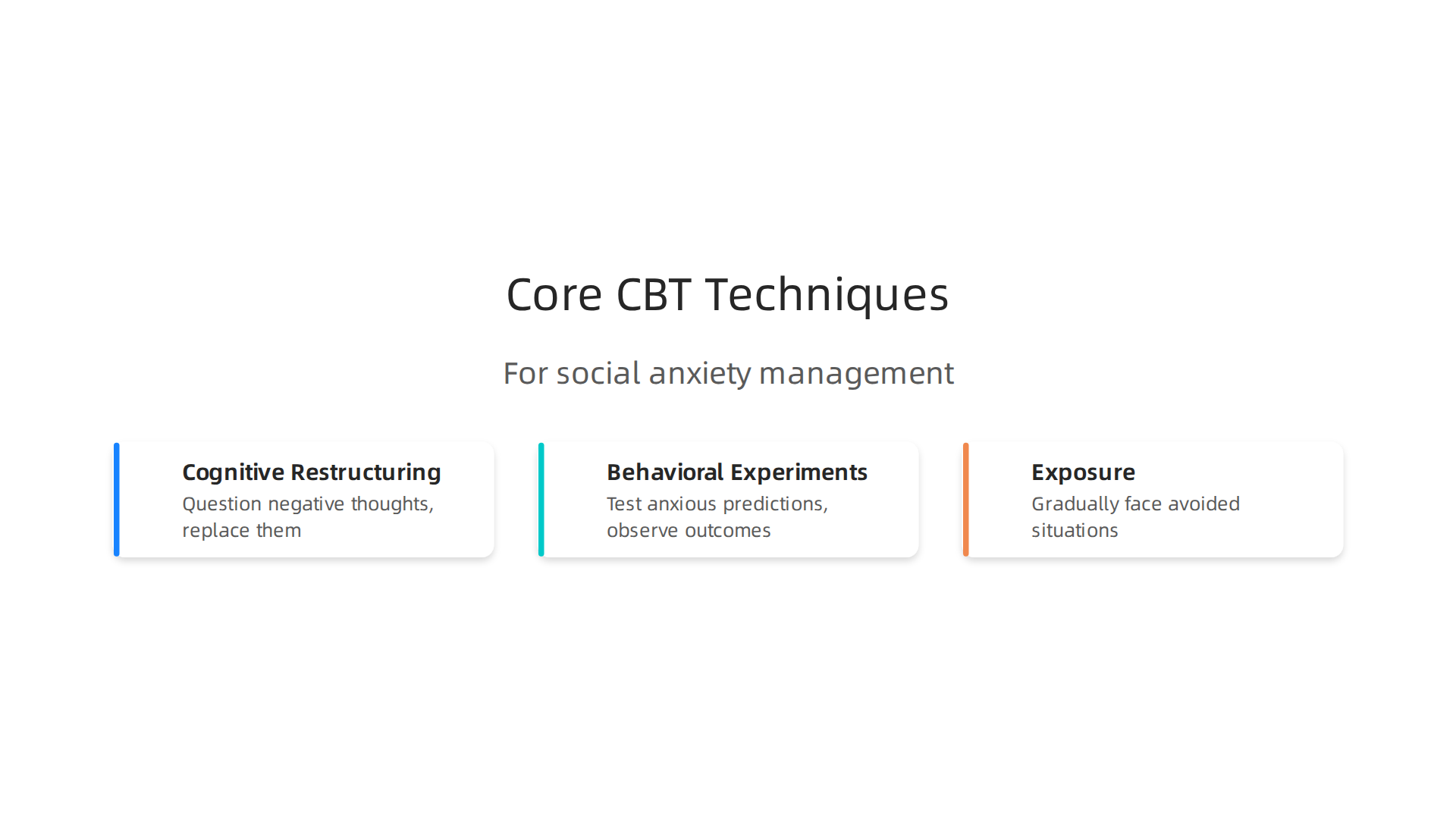
CBT for social anxiety has three main parts: cognitive restructuring, behavioral experiments, and exposure.
Let us break these down.
Cognitive restructuring is about catching your automatic negative thoughts. You know those thoughts that pop up before a social event? "Everyone will judge me." "I will say something stupid." Cognitive restructuring helps you question those thoughts. Is it really true that everyone will judge you? Probably not. You learn to replace those thoughts with more balanced ones. This is not positive thinking. It is realistic thinking.
Behavioral experiments are like mini science projects. You predict what will happen in a social situation based on your anxious thoughts. Then you test it. For example, you might think, "If I speak up in the meeting, people will laugh at me." So you try speaking up. You observe what actually happens. Most of the time, nothing bad happens. Your prediction fails. This teaches your brain that the danger was not real.
Exposure is the most important part. You gradually face the situations you avoid. You start small and work your way up. The goal is to learn that you can handle discomfort. Your amygdala learns that social situations are safe.
Here is a step-by-step example of a CBT exercise for social anxiety. Let us say you have performance anxiety about giving a presentation at work. First, write down your feared thought: "I will freeze and everyone will stare." Rate your fear from 0 to 10. Next, prepare a simple three-minute talk. Present it to one trusted coworker. Notice what happens. Did you freeze? Probably not. Rate your fear again. Then present to a slightly larger group. Keep going until your fear drops. Each time, your brain rewires itself. For more practical techniques like this, check out these coping skills for anxiety that complement CBT.
Many people wonder how to get rid of social anxiety for good. CBT is one of the most research-backed ways to do it. It does not happen overnight. But with practice, you can change the way your brain responds to social situations.
Exposure Therapy Strategies
So you have learned how CBT works. Now comes the part that makes the biggest difference. Exposure therapy is the most research-backed strategy for social anxiety. It works by helping your brain learn that the things you fear are not actually dangerous.
The idea is simple. You face your fears on purpose. But you do it in a structured way. You start with something that feels manageable and work your way up. This is called graduated exposure.
Think of it like a ladder. At the bottom is a situation that causes mild anxiety. Maybe that is making eye contact with a stranger. At the top is something really scary, like giving a speech to a large group. You start at the bottom. You stay in that situation until your anxiety drops. Then you move up one step. Research shows that about 60% to 90% of people have almost no symptoms after finishing exposure therapy, according to the American Psychological Association’s guide on exposure therapy.
There are two main types of exposure. In vivo exposure means facing your fear in real life. You actually go to the party. You actually speak up in the meeting. Imaginal exposure means picturing the feared situation in your mind. You close your eyes and imagine giving that speech. Both work. For social anxiety, in vivo is often more powerful because it gives your brain real-world proof.
Response prevention is another key piece. In exposure therapy, you purposely avoid doing the things that make you feel safe. These are called safety behaviors. Things like looking at your phone during a conversation. Or rehearsing what you will say over and over. Or avoiding eye contact. You stop those behaviors during exposure. This forces your brain to learn that you are okay without them.
This leads to habituation. When you stay in a feared situation long enough, your anxiety naturally goes down. It might spike at first. But if you stick with it, your body realizes there is no threat. Your amygdala stops sending danger signals.
Safety behavior fading goes hand in hand with habituation. You slowly let go of the crutches you have been using. At first you might need a friend with you. Then you go alone. First you might keep your hands in your pockets. Then you let them hang naturally. Each time you drop a safety behavior, your brain learns that you can handle the situation by yourself.
If you want a clear plan to put all this into practice, this step by step plan for managing anxiety disorder walks you through exactly what to do.
Exposure therapy is not easy. It takes courage. But every time you do it, you teach your brain a new lesson. You are showing it that social situations are safe. Over time, the old fear fades and a new calm takes its place.
Lifestyle and Mindfulness Approaches
Therapy techniques like CBT and exposure are powerful tools. But what you do between sessions matters just as much. Your daily habits can either fuel your anxiety or calm it down. Let us look at the lifestyle pieces that make a real difference.
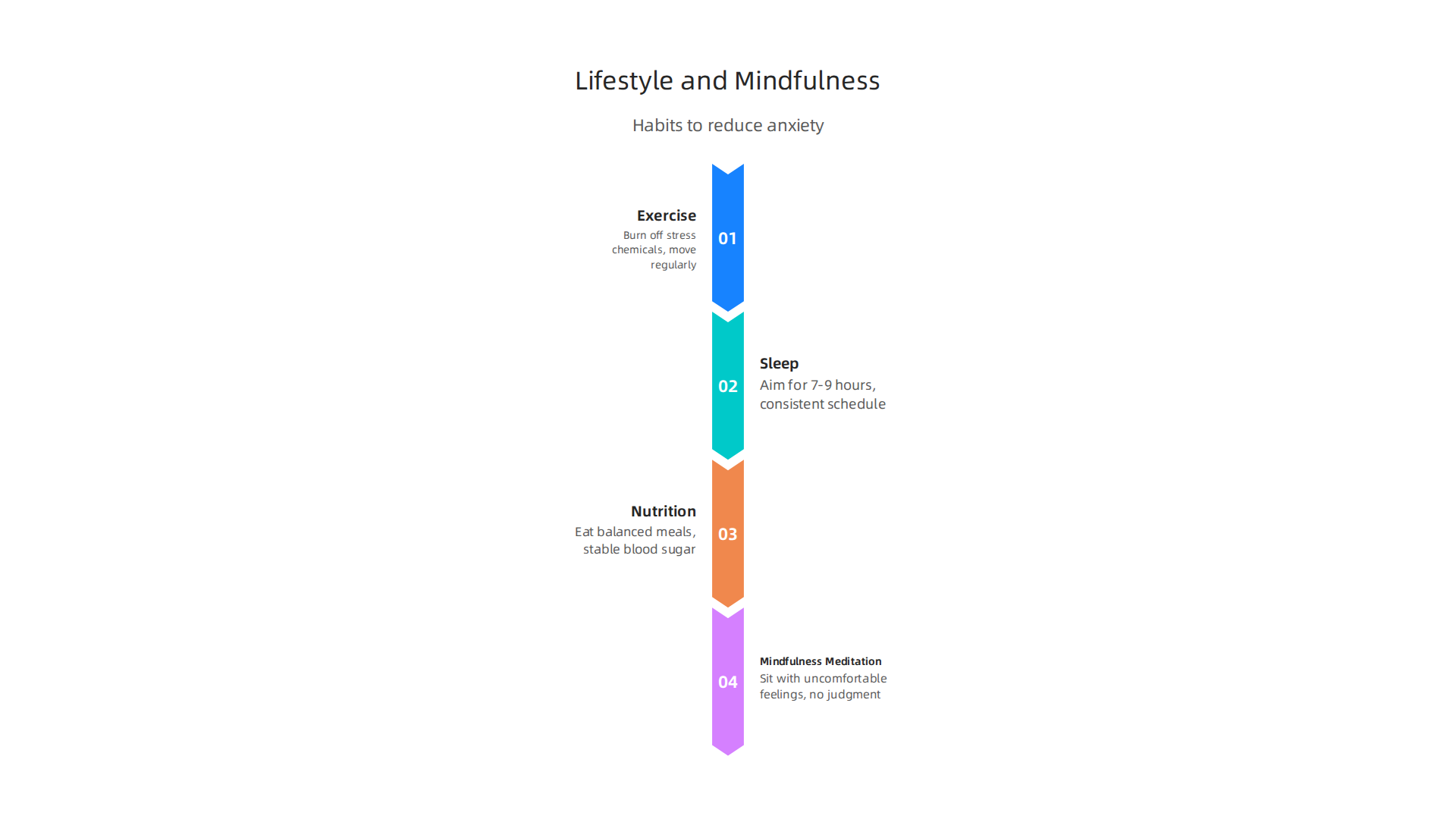
Exercise is one of the most effective natural anxiety fighters. When you move your body, you burn off the stress chemicals that build up. You do not need to run a marathon. A 20 minute walk works. So does dancing in your kitchen or doing some jumping jacks. The key is to move regularly. Studies show that combining exposure therapy with relaxation techniques like exercise can boost results.
Your sleep habits also matter a lot. Poor sleep makes your brain more sensitive to threat. You become quicker to panic and harder to calm down. Aim for seven to nine hours. Try to go to bed and wake up at the same time each day. Even one bad night can spike your performance anxiety the next day.
Nutrition plays a role too. Blood sugar crashes can feel a lot like anxiety. Your heart races. You feel shaky. You think something is wrong. Eating balanced meals with protein and healthy fats helps keep your blood sugar stable. Cut back on caffeine if you notice it makes your jitters worse. For social anxiety dsm code reference purposes, know that lifestyle factors are often discussed as part of a complete treatment plan.
Mindfulness meditation deserves special attention. It teaches you to sit with uncomfortable feelings without fighting them. You notice the anxiety without judging it. Over time, this changes your relationship with fear itself.
Here is a simple way to start. Set a timer for three minutes. Sit comfortably. Breathe normally. Pay attention to the feeling of air moving in and out of your nose. When your mind wanders guess what that is normal. Just gently bring your attention back to your breath. That is it. Do this once a day for a week.
These practices are called grounding techniques for anxiety. They anchor you in the present moment when your mind wants to race into scary future scenarios. You can learn more about these through coping skills for anxiety that build on these same ideas.
The beauty of lifestyle approaches is that they put you back in the driver’s seat. You cannot always control your thoughts. But you can control whether you go for a walk, eat a good meal, or sit quietly for three minutes. Small consistent actions add up to big changes over time.
Building Confidence and Self-Efficacy
All the lifestyle habits in the world won’t help much if you still believe you cannot handle social situations. That belief is what psychologists call self-efficacy. It is your confidence in your own ability to cope.
Dr. Albert Bandura first described self-efficacy theory decades ago. The idea is simple. If you believe you can do something, you are much more likely to try it. And if you try it, you get better at it.

This matters a lot for how to get rid of social anxiety.
Research shows that self-efficacy plays a huge role in social anxiety. One study found that increasing cognitive reappraisal self-efficacy was the main reason people got better with therapy. The researchers saw that cognitive reappraisal self-efficacy in therapy for social anxiety completely explained the improvements people made. In plain language, when people started believing they could handle their anxious thoughts, their anxiety actually dropped.
Another study looked at self-efficacy in daily life. People with low self-efficacy were more likely to avoid social situations. They also lost hope faster when anxiety hit. But those with higher self-efficacy saw better results early in treatment, according to research on self-efficacy effects on daily symptom experiences.
So how do you build self-efficacy? Here are three practical exercises.
Start a success log. Every day, write down one small social thing you handled okay. Maybe you said hello to a coworker. Maybe you made eye contact with the barista. Maybe you asked a question in a meeting. It does not have to be perfect. You are training your brain to notice what went right instead of scanning for what went wrong.
Try role-playing. Find a trusted friend or family member. Practice short conversations that make you nervous. Ask them to act like a cashier or a coworker. The first time feels awkward. But safe practice builds confidence. You make mistakes in a low-stakes setting instead of a real one. That is the whole point.
Use positive self-talk. Notice the critical voice in your head. When it says "You are going to mess up," answer back with something realistic. Say "I might feel nervous, but I have handled this before." Say "Other people are not judging me as harshly as I judge myself." The goal is not to trick yourself. It is to replace catastrophic predictions with fair ones.
The evidence backs this up. Self-efficacy was the single strongest predictor of whether people actually took action in social situations. Building it up is one of the smartest things you can do for how to get rid of social anxiety.
If you want a structured plan to keep building on these skills, you can follow a step by step plan for managing anxiety that puts all these pieces together.
Advanced: The Value Reinforcement System (VRS)
So far we have talked about lifestyle changes, building confidence, and using cognitive tricks. But there is a newer approach that takes a different angle entirely. It is called the Value Reinforcement System, or VRS for short.
Think of VRS as a recognition-based framework. Instead of fighting anxious thoughts head-on, it rewards you for doing healthy behaviors. The more you repeat those behaviors, the stronger your brain’s reward pathway becomes. Over time, the good habits start to feel automatic.
This matters a lot for how to get rid of social anxiety. Here is why.
Traditional approaches ask you to notice your anxiety and then choose a different response. That works, but it takes a lot of mental effort. VRS flips the script. It sets up a system where you earn recognition for small wins. Every time you make eye contact, start a conversation, or speak up in a meeting, the system notices. It reinforces that action. Your brain starts associating social situations with reward instead of fear.
Studies on gamification support this idea. Research on gamified interventions in mental health shows that elements like rewards, points, and levels can reduce anxiety by giving people a sense of control and accomplishment. VRS takes this further. It is not about collecting points on a screen. It is about building real recognition into your daily life.
The peer white paper Beyond Gamification, documenting VRS as the evolution of gamification into a recognition system. This means VRS moves past simple game tricks. It builds a lasting structure that rewires your brain over time.
And here is the best part for those dealing with performance anxiety or general social fear. VRS is designed to offset susceptibility to anxiety by reinforcing positive routines. When you consistently practice social behaviors and get rewarded for them, your brain learns a new pattern. The old anxious pattern gets weaker. The new confident pattern gets stronger.
For a deeper look at how this works on a brain level, check out the peer white paper The Science of Gamification, which formalizes the behavioral mechanism. It explains why recognition-based systems work better than punishment or avoidance strategies.
If you want a structured way to start applying these ideas today, you can read more about what is anxiety at a foundational level and then build up from there.
When to Seek Professional Help
The self-directed approaches we have talked about so far can make a real difference. But sometimes you need more than a system or a set of skills. You need a trained professional who can guide you through the deeper layers of social anxiety.

How do you know when it is time to reach out? Here are some red flags.
Your daily life is severely affected. If social anxiety keeps you from going to work, attending school, or maintaining relationships, that is a clear sign. You might avoid leaving the house or turn down every invitation. When avoidance takes over your life, professional support can help you break the cycle.
You have thoughts of hurting yourself. Suicidal thoughts are always a reason to seek help immediately. If you ever think about ending your life, call a crisis line or go to the emergency room. You can also explore proven treatment for suicidal thoughts and crisis support to find the right resources.
Physical symptoms are overwhelming. Panic attacks, rapid heartbeat, sweating, trembling, or feeling like you might faint in social situations are signs that your body is stuck in fight-or-flight mode. A professional can teach you grounding techniques for anxiety and other tools to calm your nervous system.
Nothing you try seems to work. You have read articles, tried breathing exercises, and pushed yourself into social situations. But the anxiety keeps coming back. This is common. Sometimes the patterns are too deep to untangle alone. That is where therapy comes in.
Types of Professionals and Therapy Options
Different experts can help with social anxiety. Here is a quick overview.
| Professional | What They Do |
|---|---|
| Psychiatrist | A medical doctor who can prescribe medication and diagnose complex cases |
| Psychologist | Holds a PhD or PsyD and provides talk therapy and psychological testing |
| Licensed therapist | A licensed clinical social worker (LCSW), licensed professional counselor (LPC), or marriage and family therapist (LMFT) who offers counseling |
The most researched therapy for social anxiety is cognitive behavioral therapy (CBT). Studies show that CBT helps people reduce avoidance and change negative thought patterns. In fact, research on long-term outcomes in CBT for social anxiety found that improvements often continue even after treatment ends. CBT teaches you to recognize distorted thoughts, face feared situations step by step, and build confidence over time.
If you are ready to take that step, learning more about clinical mental health counseling for anxiety can help you understand what to expect from therapy. A good therapist will tailor the approach to your specific struggles, whether that is performance anxiety, general social fear, or the social anxiety DSM code that officially describes the condition.
You do not have to figure this out alone. Asking for help is a sign of strength, not weakness. It might be the best decision you make in your journey toward how to get rid of social anxiety for good.
Conclusion: Building Your Personal Roadmap to Freedom
You have now seen the full picture of how to get rid of social anxiety. Understanding your triggers, practicing cognitive behavioral therapy techniques, facing feared situations step by step, improving your lifestyle habits, and exploring tools like virtual reality social skills training are all proven paths forward. Each one works in a different way. Together, they form a complete toolkit.
Here is the most important thing to remember. You do not need to do everything at once. Pick one small step today. Maybe that means naming one trigger you noticed this week. Maybe it means trying a single grounding exercise the next time you feel anxious. Small steps build momentum. And momentum is what leads to lasting change.
Start tracking your progress. Write down what you try and how it feels. Look back after a week or a month. You will likely see more progress than you realize. That evidence will keep you going.
Every strategy shared here is backed by research and expert insight. You are not guessing. You are using tools that have helped countless other people find relief. Trust the process and trust yourself.
If you want a clear structure to follow, this step by step plan for managing anxiety disorder gives you a simple framework you can start using today.
And here is one more insight worth keeping in mind. The same principles that make virtual reality training effective for social anxiety also apply to everyday life. When you track your own small wins and reward yourself for showing up, you reinforce the behaviors you want to grow. The field note on the Value Reinforcement System explains this idea in depth and shows how it has evolved through three distinct eras.
Your road to freedom is personal. But you do not have to walk it without guidance. Every tool you need is already within reach. Take that first step. Your future self will thank you.
Summary
This article explains what social and performance anxiety are, how they differ, and why they can become disabling if left untreated. It reviews the neuroscience behind anxious reactions — from the amygdala to neurotransmitters — and shows how therapies like CBT and exposure work to rewire the brain. Practical, research-backed strategies appear throughout: cognitive restructuring, behavioral experiments, graduated exposure, and daily lifestyle changes such as exercise, sleep, and mindfulness. The piece also introduces the Value Reinforcement System (VRS), a recognition-based approach to reward healthy social habits, and offers concrete steps to build self-efficacy. Finally, it outlines when to get professional help and how to combine treatments into a personal roadmap so readers can steadily reduce avoidance and regain confidence in social situations.