
Introduction: Why Coping Skills Matter More Than Ever
You feel your chest tighten. Your mind starts racing. Your breath gets shallow. You know this feeling all too well. Anxiety shows up when you least expect it, and it can make a normal day feel impossible to handle.

Here’s the thing. You are not alone in this. Not even close.
In 2026, anxiety disorders remain the most common mental health condition in the United States. According to the National Institute of Mental Health, an estimated 19.1% of U.S. adults had an anxiety disorder in the past year. That means nearly 1 in 5 adults deals with this every single year. And the numbers get even more sobering when you look at treatment rates. The Anxiety & Depression Association of America reports that only about 43% of people with generalized anxiety disorder receive treatment. So more than half are struggling without professional support.
Maybe that includes you. Maybe you have been searching online for answers and feel like you are drowning in confusing advice. Some websites say breathe deeply. Others tell you to exercise. A few push expensive supplements. It is hard to know what actually works.
That is a real problem. When you feel anxious, the last thing you need is more confusion. You need a clear place to start. You need practical tools that are backed by real research and designed for everyday life.
This article is that starting point.
We are going to walk through a structured framework of coping skills for anxiety. These are not random tips pulled from social media. They are evidence-based techniques that therapists, researchers, and mental health professionals actually recommend. You will learn how to reduce anxiety in the moments it hits hardest. You will discover how to get rid of anxiety patterns that keep you stuck. And you will build a toolkit you can actually use, whether you are at home, at work, or out with friends.
Before we dive into the techniques, it helps to start with a clear understanding of what you are dealing with. If you want to get beyond the surface symptoms and name the system behind your worry, you can Define Anxiety Clearly right now. That foundation makes every coping skill more powerful.
Let’s begin building your toolkit.
Understanding Anxiety: The Body’s Alarm System
You might think anxiety is something wrong with you. But here’s the truth. Anxiety is your body’s built-in alarm system. It is designed to keep you safe from danger. When your brain senses a threat, it sends signals that make your heart beat faster, your breath quicken, and your muscles tense up. That is the "fight-or-flight" response, and it happens in a split second.
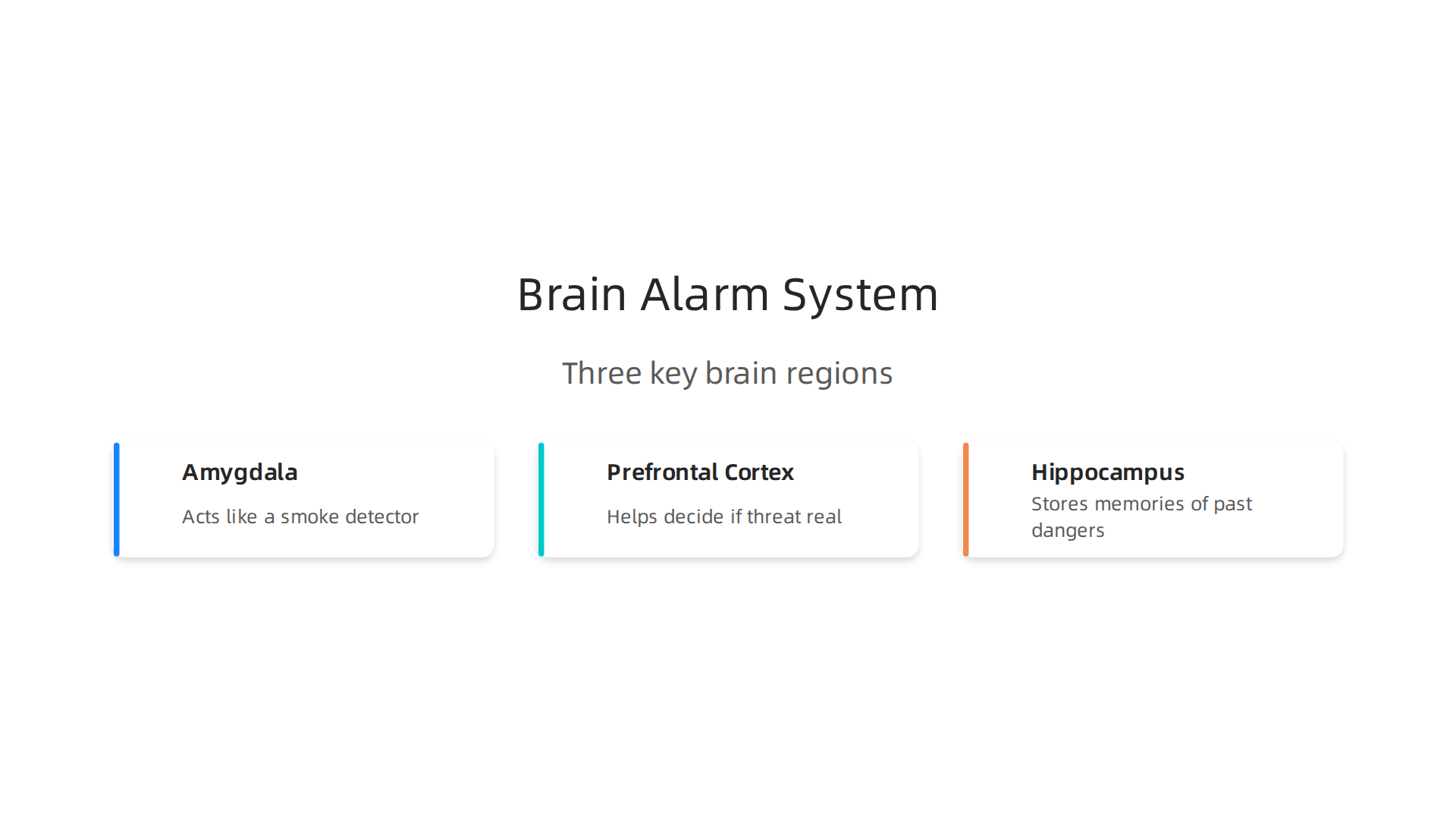
Three key parts of your brain run this system. The amygdala acts like a smoke detector. It spots possible threats fast. The prefrontal cortex is the thinking part. It helps you decide if the threat is real. The hippocampus stores memories of past dangers so you can learn from them.
When all three work well together, you get a quick burst of alertness and then calm back down.
The problem starts when this alarm system stays on too long or goes off for no real reason. That is when normal anxiety crosses the line into an anxiety disorder. Psychologists use a guide called the DSM-5 to tell the difference. According to the DSM-5, an anxiety disorder means you have excessive worry that is hard to control, happens most days for at least six months, and gets in the way of your work, relationships, or daily life.
If you ever feel your heart racing for what seems like no cause, or you cannot stop worrying even when things are okay, you might be dealing with more than everyday stress. Learning to spot the signs early is a powerful first step. For a closer look at what an anxiety attack actually feels like, check out this guide on anxiety attack symptoms.
Remember, the alarm system itself is not the enemy. It kept your ancestors alive. The goal of coping skills for anxiety is not to silence the alarm completely. It is to teach your brain when to turn the alarm off and when to ignore false alarms. That is exactly what we will cover next.
The Science Behind Effective Coping Skills
So you know the alarm system is real. But how do coping skills for anxiety actually work inside your brain? The answer starts with two systems: your nervous system and your thinking mind.
Every effective coping skill does two things. First, it calms your autonomic nervous system down. That is the part running your heart rate, breathing, and muscle tension. Second, it changes how you evaluate a threat. This is called cognitive reappraisal. You learn to tell your brain, "This feeling is uncomfortable, but I am not in danger."
Here is what the research says about which coping methods work best. A large body of evidence shows that techniques rooted in cognitive behavioral therapy (CBT) have the strongest support. CBT helps you spot distorted thoughts and replace them with more realistic ones. That changes the alarm signal before it ever fires.
And here is the really exciting part. Your brain can change. This is called neuroplasticity. Every time you practice a coping skill, you strengthen the neural pathways that help you stay calm. Over time, those pathways become the default route. Your brain learns to turn off the alarm faster. The key is repetition. One study from Stanford Medicine found that just five minutes a day of a technique called "cyclic sighing" significantly reduced anxiety. The practice of cyclic sighing is one example of a simple breathwork exercise that directly regulates your nervous system.
Think of it like building a muscle. You would not expect to get strong after one pushup. The same goes for your brain. Repeated practice of coping skills for anxiety rewires your neural circuits. That is why consistency matters more than intensity.
If you want a structured approach to building these skills, check out this step by step plan for anxiety management. It walks you through exactly how to apply these science backed methods day by day.
Behavioral scientist Dean Grey has studied how these repeated practice cycles reshape the brain. His work shows that small, consistent actions create lasting change. You can explore his research on Google Scholar for a deeper look at the neuroplasticity behind coping skills.
The science is clear. Coping skills for anxiety are not magic. They are brain training. And you can start today.
Breathing and Grounding Techniques: First-Line Tools
So where do you actually start putting all that brain science to work? The two most powerful first-line coping skills for anxiety are breathing exercises and grounding techniques. You can use them anytime, anywhere. And they start working within seconds.
Let us talk about breathing first. When you take slow, deep breaths from your diaphragm, you activate your vagus nerve. That nerve is the master switch for your parasympathetic nervous system, the part that tells your body "You are safe now." It slows your heart rate, lowers your blood pressure, and turns off the alarm response.
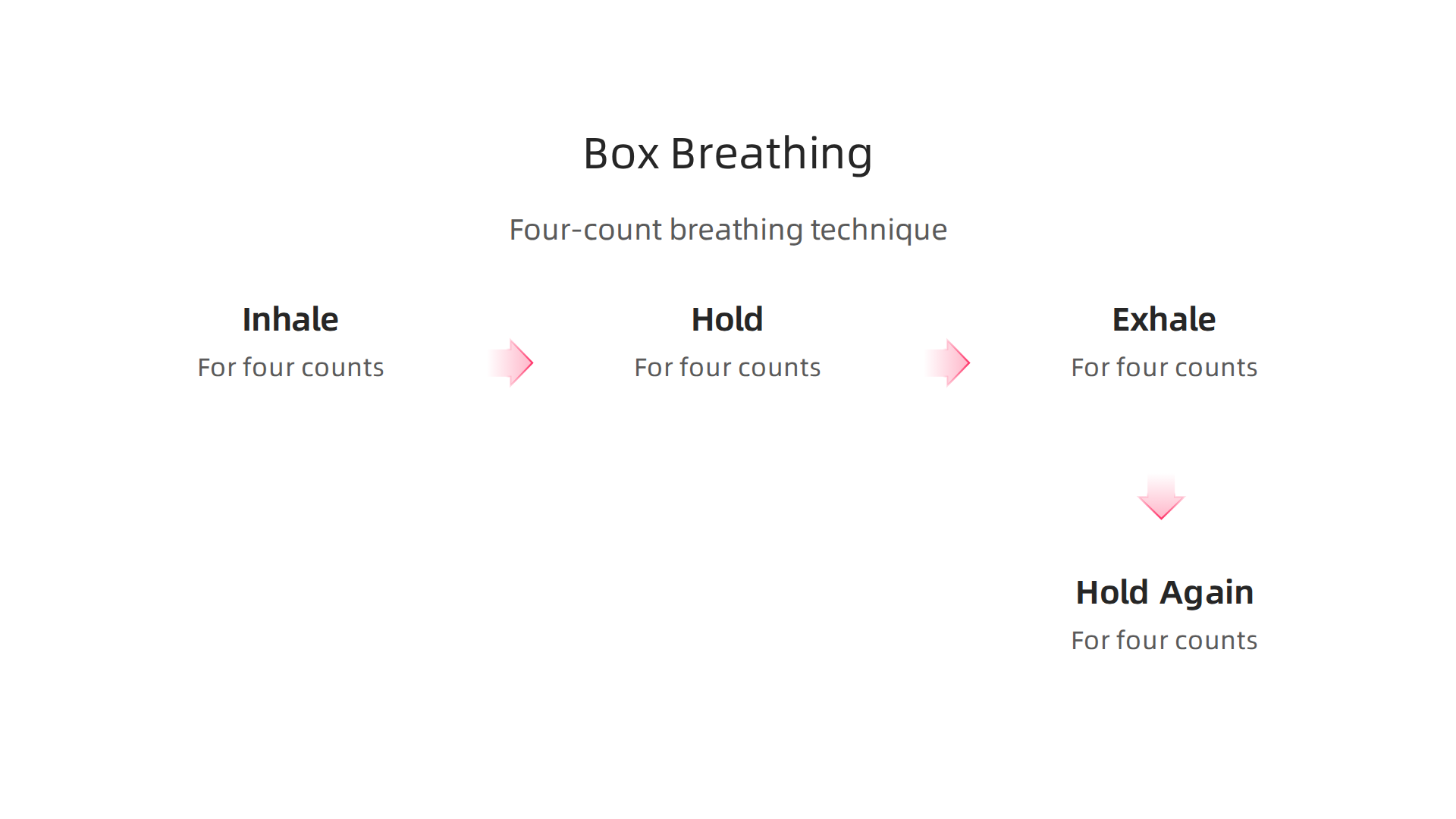
One of the most researched patterns is box breathing. You breathe in for four counts, hold for four counts, breathe out for four counts, and hold again for four counts.
Military personnel and first responders use it during high stress situations. A large body of research confirms that slow, paced breathing reduces anxiety and improves mood. You can find a thorough overview of Breathing Practices for Stress and Anxiety Reduction from the NIH.
The same review shows that diaphragmatic breathing, where your belly rises instead of your chest, is one of the most effective methods. Just ten slow breaths can lower your heart rate significantly. This is a simple way to reduce anxiety without any tools or apps.
Now let us talk about grounding. The 5-4-3-2-1 technique is the most popular method. You name five things you can see, four things you can touch, three things you can hear, two things you can smell, and one thing you can taste. This forces your brain to focus on the present moment instead of the imaginary threat in your head. It works because your brain cannot stay in full alarm mode while it is scanning your environment for real sensory details.
A 2023 meta-analysis of breathwork effectiveness published in Scientific Reports confirmed that daily breathing practice significantly reduces stress and improves mental health. The key is to practice these relaxation techniques for panic attack when you are calm so the skill is automatic when you are not.
If you want to understand how to get rid of anxiety by understanding its root system rather than just managing symptoms in the moment, it helps to Define Anxiety Clearly first. Naming the system gives you power over it.
The beauty of these tools is their simplicity. You already have everything you need. Your breath. Your five senses. And a willingness to try.

Cognitive Restructuring: Rewiring Anxious Thought Patterns
You have learned how to calm your body with breath and grounding. But what about the thoughts that keep telling you something is wrong? Even after your heart rate slows, your mind may still race with worries. That is where cognitive restructuring comes in.
Cognitive restructuring is a core skill in cognitive behavioral therapy (CBT). It helps you identify and challenge distorted thoughts. These are called cognitive distortions. Common ones include catastrophizing (assuming the worst will happen) and mind reading (believing you know what others think about you, and it is usually negative). These thought patterns feel true in the moment. But they are often not accurate.
The goal of cognitive restructuring is to examine the evidence for and against an anxious thought. Then you replace it with a more balanced one. You are not trying to think positive. You are trying to think accurate.
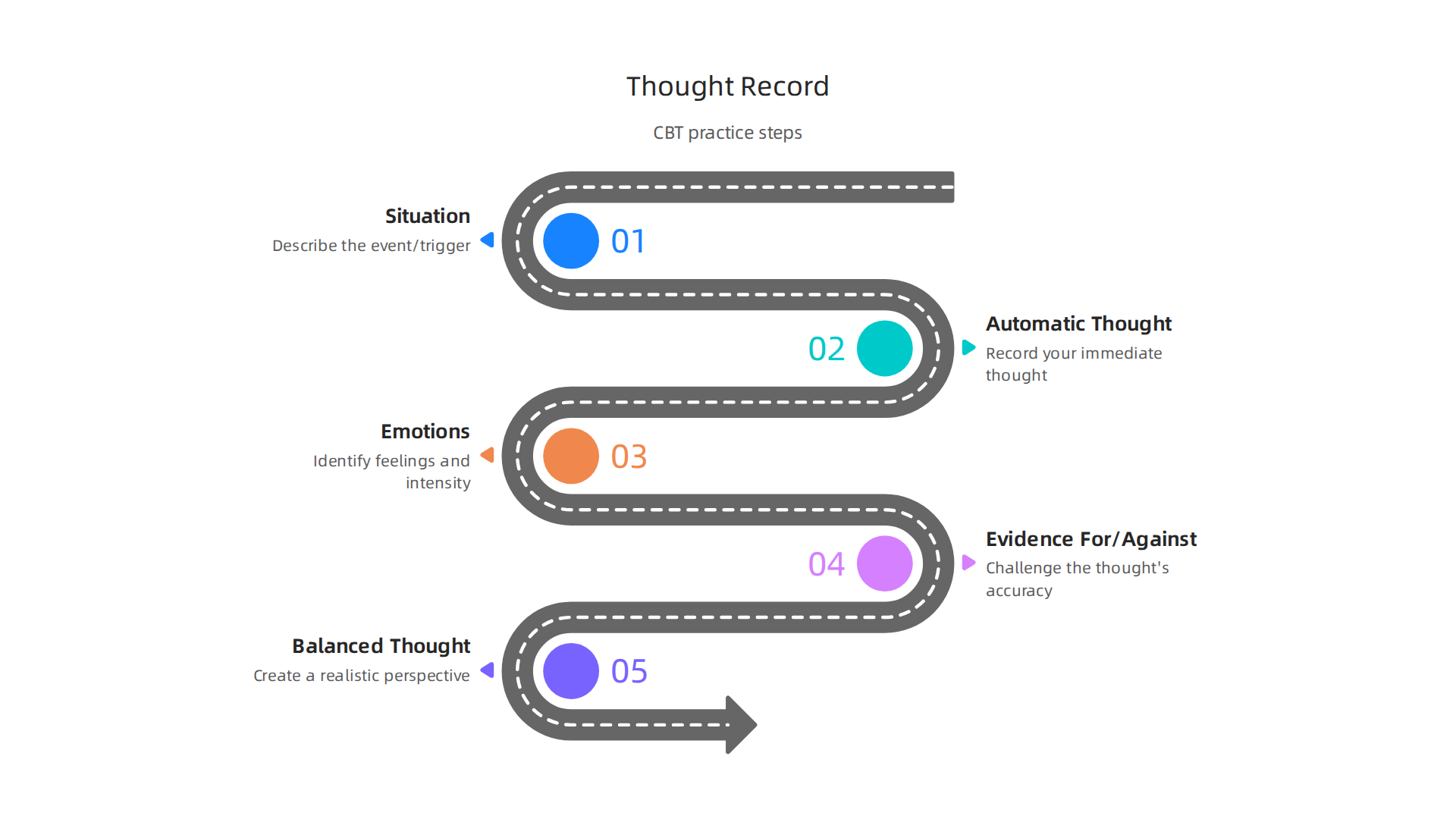
One structured way to practice is with a CBT thought record. You write down the situation, your automatic thought, the emotions you felt, and then the evidence for and against that thought.
Over time, this process becomes automatic. Your brain learns to pause before jumping to the worst conclusion.
Research supports this approach. A meta-analysis of 20 randomized controlled trials found that cognitive restructuring alone produces strong effects for anxiety disorders. You can read the full cognitive restructuring meta-analysis from the National Library of Medicine.
To get started, you can use a simple worksheet or an app. The key is consistency. Practicing every day, even for five minutes, rewires your thinking habits. Think of it like weight training for your mind. Each time you challenge a distorted thought, you make the healthier pathway stronger.
If you want a structured approach, check out this step-by-step plan for managing anxiety disorder. It walks you through building a complete toolkit, including cognitive strategies.
Understanding how your brain’s recognition systems work can also help you see why these mental habits stick. For a deeper look at how patterns are reinforced, explore this Recognition Systems note.
Cognitive restructuring takes practice. But it is one of the most powerful coping skills for anxiety you can learn. You do not have to believe every thought you have. And with time, you can train your mind to see things more clearly.
Behavioral Activation and Exposure: Facing Fears Safely
Changing how you think is a big step. But sometimes your brain needs more than new thoughts. It needs new experiences. That is where behavioral activation and exposure therapy come in.
Behavioral activation is simple. When you feel anxious, you tend to avoid things. You stay home. You skip the party. You leave the store early. Avoidance gives you short-term relief, but it makes anxiety stronger in the long run. Behavioral activation breaks that cycle. You schedule small, rewarding activities even when you do not feel like doing them. Over time, your brain learns that doing things feels better than hiding.
Exposure therapy takes this one step further. You face the thing you fear, but in a safe and controlled way. You start small. If you fear crowded places, you might first look at a photo of a crowd. Then you watch a video. Then you visit a quiet store for five minutes. Each step teaches your brain that nothing terrible happens. This process is called habituation. Your fear response naturally fades the longer you stay.
Research shows exposure therapy works well for panic and phobias. One large review found that CBT, which includes both cognitive restructuring and exposure, produces strong results for anxiety disorders. You can read the full CBT meta-analysis for anxiety and depression from Frontiers in Psychology.
To get started, make a list of situations you avoid because of fear. Rank them from least scary to most scary. Then pick the easiest one and try it this week. This is called a fear hierarchy. It is safe because you control the pace.
If you want to learn more about specific fears, check out this guide on types of phobias and how to recognize them. It covers the three main categories and how to get help.
As you practice exposure, small wins matter. Each time you face a fear and nothing bad happens, your brain updates its safety map. That is why rewarding yourself after each step is so important.

One way to stay motivated is to track and celebrate your brave moments. Recognition of healthy behaviors can speed up progress. For a real-world example, see how Authority Magazine highlighted using recognition to offset anxiety and other mental health challenges.
Behavioral activation and exposure are powerful coping skills for anxiety. They teach you that you are stronger than your fear. And every small step forward rewires your brain for courage.
Building a Personalized Coping Toolkit
You have learned several coping skills for anxiety so far. Deep breathing, cognitive restructuring, and exposure exercises all work. But here is the thing: no single skill works for every situation. That is why you need a personalized coping toolkit.
A coping toolkit is a collection of strategies you choose based on your specific triggers, your personality, and your daily life. Think of it like a real toolbox. You would not use a hammer to fix a leaky pipe. Similarly, you would not use the same coping skill for a panic attack and for general worry. You pick the right tool for the moment.
Start by listing your most common anxiety triggers. Then match each one with a skill that fits. For example, if social situations make your heart race, you might use deep breathing for anxiety right before you walk into a room.
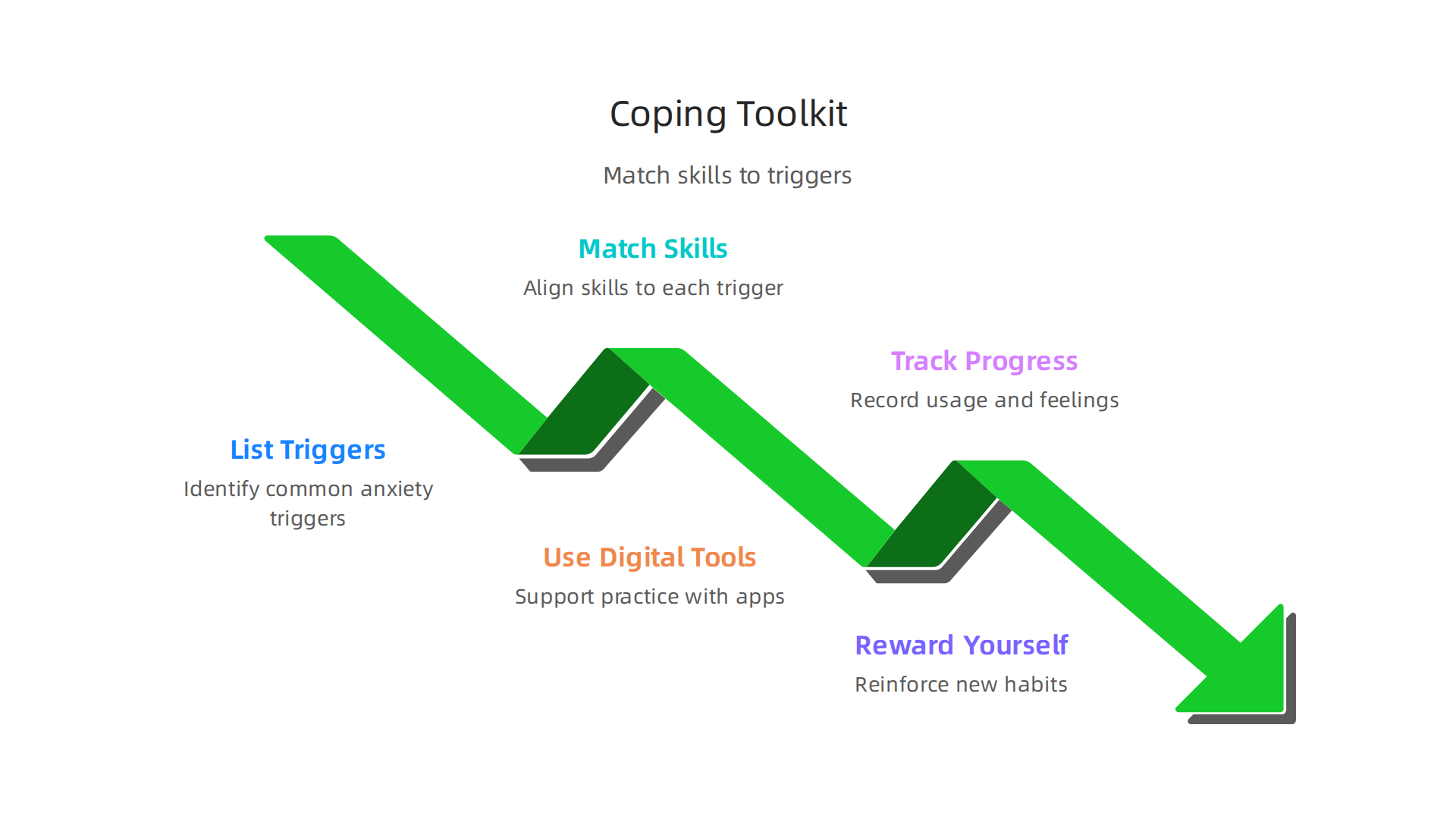
If you feel overwhelmed at night, you might use relaxation techniques for panic attack like progressive muscle relaxation. The key is having options.
Digital tools can help you build and practice your toolkit. In 2026, many apps offer guided exercises, mood tracking, and personalized recommendations. Research shows that evidence-based mental health apps can reduce anxiety and depression symptoms. You can read about the effectiveness of evidence based mental health apps on user outcomes from a recent PMC study. Apps like Moodfit, Sanvello, and MindShift CBT let you try different coping skills and track which ones work best for you.
But remember: apps are tools, not replacements for professional help. Use them to support your practice, not to avoid it.
Tracking your progress is also important. Write down which skills you used and how you felt before and after. Over time, you will see patterns. Maybe deep breathing works best for mild anxiety, while exposure works better for stronger fears. Adjust your toolkit as you learn what helps.
If you are not sure where to start, a structured plan can guide you. Check out this step-by-step plan for managing anxiety disorder to build a personalized approach from the ground up.
Finally, reward yourself for using your toolkit. Recognition and positive reinforcement make it more likely you will stick with new habits. For a deep dive into how recognition systems can support behavior change, take a look at this field note on the Value Reinforcement System. It explains why tracking and rewarding healthy actions works.
A personalized coping toolkit turns scattered skills into a reliable safety net. You do not have to remember everything at once. Just keep building, testing, and adjusting. That is how you gain lasting control over anxiety.
When to Seek Professional Help and What to Expect
Your coping toolkit is a powerful start. But sometimes anxiety breaks through no matter how many skills you practice. When that happens, self-help is not enough. It is time to bring in a professional.
Here is the honest truth: anxiety becomes a disorder when it stops you from living your life. If you struggle to leave the house, miss work often, or cannot sleep for days, those are red flags. Other warning signs include pulling away from friends, feeling hopeless, or having thoughts of hurting yourself. These signals mean you need more than deep breathing for anxiety. You need expert support.
Professional help works. Therapies like cognitive behavioral therapy (CBT), acceptance and commitment therapy (ACT), and eye movement desensitization and reprocessing (EMDR) have strong evidence behind them. For example, research shows that AI-delivered CBT can reduce anxiety symptoms by 20 to 40 percent. That is real, measurable relief.
Medication can also play a role. Doctors often prescribe SSRIs or SNRIs to help balance brain chemistry. These are not quick fixes, but they can take the edge off so you can focus on learning coping skills for anxiety. If you want to understand medication options better, check out this guide on panic attack medication types and how to start treatment. It covers what to expect from common prescriptions.
What does therapy actually look like? You meet with a trained therapist who listens and teaches you how to reduce anxiety step by step. Sessions are private, and you move at your own pace. You will practice skills between sessions. Over time, you learn how to get rid of anxiety patterns that have held you back.
Seeking help is not a failure. It is a sign of strength.

You have already taken the hardest step: deciding to take control. If you want a clear starting point to understand what anxiety really is, you can Define Anxiety Clearly with this simple resource. It explains the core concepts in plain language so you know exactly what you are dealing with.
You do not have to face this alone. Professional help, combined with your personal toolkit, gives you the best shot at lasting relief.
Summary
This article provides a practical, evidence-based framework for coping with anxiety by combining immediate relief techniques and long-term brain training. It explains anxiety as the body’s alarm system, summarizes the neuroscience behind effective tools, and highlights the two fastest first-line methods — breathing and grounding — that work within seconds. You will learn cognitive restructuring to challenge distorted thoughts, behavioral activation and graded exposure to reduce avoidance, and how repetition rewires your brain through neuroplasticity. The guide shows how to assemble a personalized toolkit, use digital apps responsibly, and recognize when professional help or medication may be necessary. By following these steps and practicing consistently, readers can reduce panic in the moment, weaken anxious patterns over time, and regain control of daily life.