

Introduction
Have you ever felt like someone was always out to get you? Most of us shake that feeling off quickly. But for people living with paranoid personality disorder, that suspicion never really goes away. It colors every conversation, every relationship, and every decision.
Paranoid personality disorder (PPD) is a chronic mental health condition. People with PPD carry a deep, lasting distrust of others. They assume that people are lying, cheating, or trying to harm them, even when there is no proof.

This isn’t just being cautious. It affects about 9.1% of U.S. adults who live with some form of personality disorder.
Here’s the thing. Many people mix up paranoid personality disorder with other conditions like delusional disorder. That confusion leads to stigma and often wrong diagnosis. When someone is overly suspicious, others may label them "crazy" or "unreasonable." But PPD is its own real diagnosis, and understanding it matters for everyone.
In this guide, we will look at what paranoid personality disorder actually looks like. We will also compare it to other conditions like delusional disorder and antisocial personality disorder symptoms. And we will talk about the role of alexithymia treatment, because trouble naming emotions can make things worse.
Our goal is simple. We want to give you clear, helpful facts so you can spot the signs, support someone who needs help, or get answers for yourself.
If you are also curious about how personality disorders relate to anxiety, you can read about narcissistic personality disorder symptoms to see the differences.
Before we dive deeper, let’s make sure we are on the same page about basic terms. Define Anxiety Clearly to start building your foundation.
What Is Paranoid Personality Disorder?
Paranoid personality disorder (PPD) is a long-term mental health condition. People with PPD have a deep and constant distrust of others. They believe that other people want to hurt, lie to, or take advantage of them. And this happens even when there is no real evidence to support it.
According to the DSM-5, which doctors use to diagnose mental health conditions, PPD has specific signs. To be diagnosed, a person must show at least four of these seven symptoms:
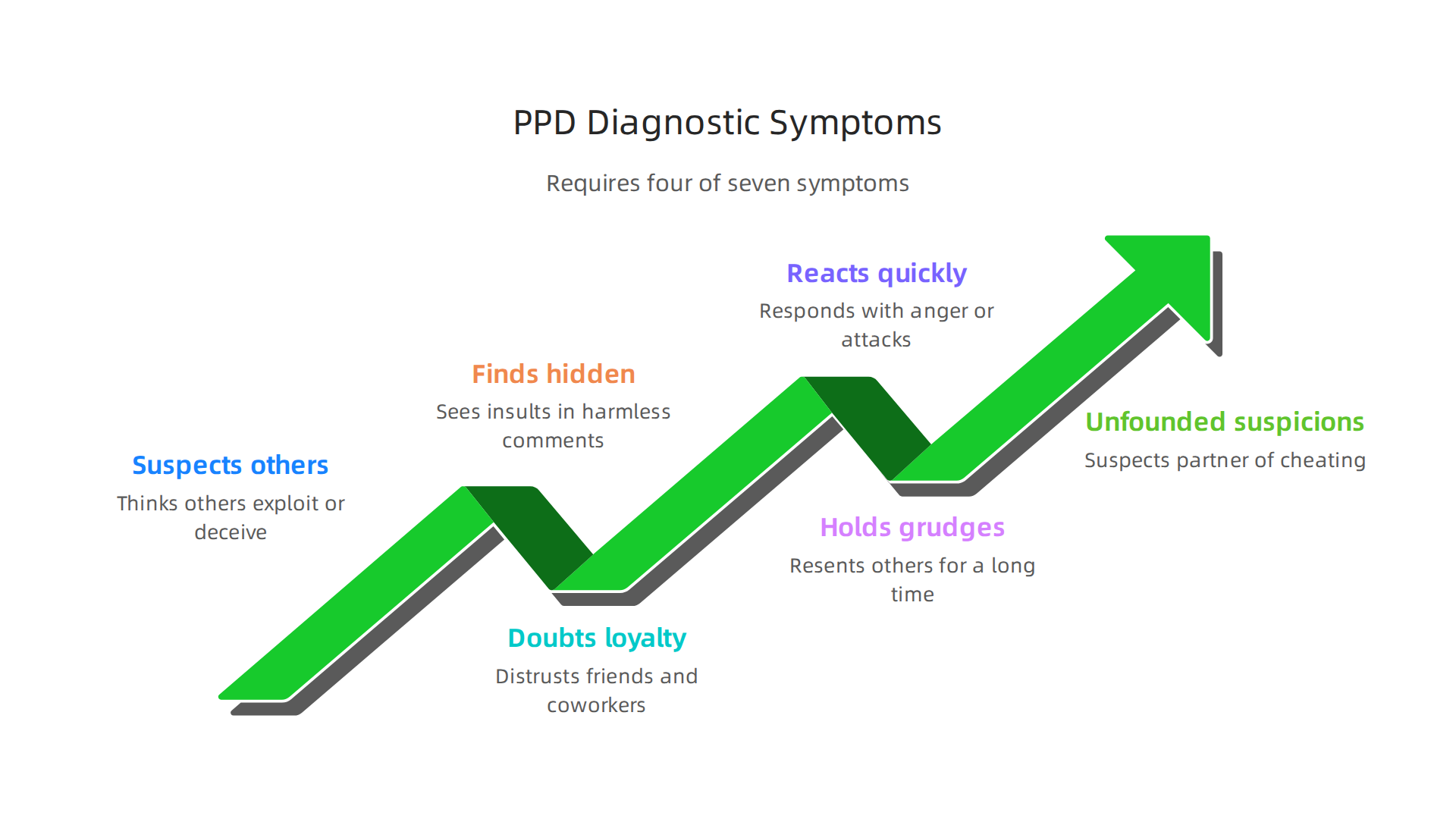
- Suspects others are exploiting or deceiving them, without a good reason
- Doubts the loyalty or trustworthiness of friends and coworkers
- Finds hidden insults or threats in harmless comments
- Holds grudges for a long time
- Reacts quickly with anger or attacks back when they feel slighted
- Has unfounded suspicions that their partner is cheating
- Reluctant to confide in others because they fear the information will be used against them
The Cleveland Clinic explains that this pattern of distrust is not just occasional. It is a core part of how the person sees the world.
Now, here is the important part. Early recognition of paranoid personality disorder can make a real difference. When someone gets help early, they learn how to handle their suspicions better. They also have a chance to keep relationships from falling apart. Therapy can teach coping skills that reduce the pain of constant distrust.
If you want a clear foundation on mental health terms first, a simple resource like Define Anxiety Clearly can help you understand the basics before diving deeper.
We will look at the specific DSM-5 criteria in the next section, so keep reading.
Core Symptoms of PPD
The core symptoms of paranoid personality disorder all revolve around a deep, unwarranted distrust. People with PPD constantly think others are out to harm or deceive them. They question the loyalty of even close friends and family. As the Merck Manual explains, this is a pervasive pattern that colors every interaction.
These individuals are almost always on guard. They pick up on hidden insults or threats in harmless comments. They hold grudges for a long time and react with sudden anger if they feel attacked. The StatPearls article notes they may be quick to counterattack, which often pushes people away.
Here is an important rule for doctors. These symptoms must not be better explained by another condition, like schizophrenia. Getting the right diagnosis matters.
If you are trying to tell PPD apart from other issues, check out this guide on how to recognize the symptoms of anxiety and tell them apart from other disorders. It can help you see the differences.
The first step is to clearly name what you are dealing with. A resource like Define Anxiety Clearly gives you simple, reliable definitions for terms like paranoid personality disorder and many others. Knowledge is power, so start building yours today.
Prevalence and Demographics
How common is paranoid personality disorder? According to the Merck Manual, PPD affects about 2.3% to 4.4% of people worldwide. That makes it one of the more frequent personality disorders you’ll see.
The numbers shift a little by gender. PPD is diagnosed slightly more often in men than in women. And if you look at places like prisons or psychiatric hospitals, the rate jumps much higher. That makes sense, because deep distrust often leads to conflict.
For a closer look at how PPD stacks up against other conditions, check out this guide on narcissistic personality disorder symptoms.
Paranoid Personality Disorder vs. Delusional Disorders
If you’ve ever wondered whether paranoid personality disorder and delusional disorder are the same thing, you’re not alone. They get mixed up all the time.

But here’s the thing: while both conditions involve fixed, suspicious beliefs, they work quite differently.
Delusional disorder usually centers on one or a few specific non-bizarre delusions. Think of someone who firmly believes they are being followed or poisoned. The rest of their thinking might stay pretty clear. With paranoid personality disorder, the distrust shows up everywhere. It’s a lifelong pattern of suspicion that touches most interactions according to a comparison from South Jersey Recovery.
Scope matters too. PPD is woven into the personality itself. It starts early and stays constant. Delusional disorder tends to come in episodes. Someone might function well between episodes, while PPD affects daily functioning almost all the time. A deep dive by Good Health Psych explains that the main difference lies in the nature of the suspicious thoughts themselves.
Why does this distinction matter so much? Because treatment looks different for each condition. Getting the diagnosis right changes the whole plan. If you’re trying to sort out similar conditions, our guide on how to recognize the symptoms of anxiety and tell them apart from other disorders can help you see the bigger picture.
Ready to build on this understanding? Define Anxiety Clearly and get a solid foundation for recognizing what you or someone you care about is really dealing with.
Key Differences in Thought Patterns
So how do you tell them apart by just looking at how a person thinks? It comes down to two things: how wide the suspicion spreads and how intense it gets.
In paranoid personality disorder, the suspiciousness is what experts call ego-syntonic. In plain English, that means the person feels their distrust makes total sense. It fits who they are. The suspicion is also pervasive. It touches nearly every part of life. At home, at work, with strangers. It never really takes a break according to The Phoenix Recovery Center.
Delusional disorder works differently. The false beliefs stay circumscribed. That means they are limited to one topic or situation. Someone might believe the government is following them, but handle finances, friendships, and daily tasks just fine. The delusions can be non-bizarre (like being poisoned) or bizarre (like being controlled by a machine). A breakdown from Good Health Psych clarifies that PPD never reaches that full delusional intensity.
Here is another big clue. People with PPD rarely hold one single false belief. Instead they build a whole network of doubts. One suspicion feeds another until everything seems connected. With delusional disorder, the false idea stays contained. It does not spread to other areas.
Getting this straight changes how you understand the condition. If you want to see how other serious conditions compare, our plain language guide on schizophrenia symptoms and diagnosis can help you spot the differences clearly.
Ready to turn confusion into real understanding? Define Anxiety Clearly and get a solid foundation for recognizing what you or someone you care about is truly dealing with.
Overlap and Comorbidity
So what happens when these two conditions show up together? It is more common than you might think. Both PPD and delusional can appear alongside depression, anxiety, or substance use disorders. That mix makes diagnosis trickier and treatment more layered.
Here is the thing. Some experts think PPD might actually be a risk factor for developing full delusional disorder later on. The long-standing suspicion wears down your ability to trust, and over time that can grow into a fixed false belief Good Health Psych.
Why does this overlap happen? It comes down to shared roots. Genetic makeup and early life environment play a big role in both conditions. If your brain is wired for suspicion and you face ongoing stress, you are more likely to cross that line from personality trait to delusion.
This is why getting a clear picture matters so much. A thorough evaluation looks at both the personality pattern and any separate episodes of delusion. If you are trying to sort out these symptoms in yourself or someone you know, our guide on how to recognize the symptoms of anxiety and tell them apart from other disorders gives you a practical starting point.
Ready to move past confusion? Define Anxiety Clearly and start building the solid foundation you need to understand what is really going on.
Causes and Risk Factors of PPD
Why do some people develop paranoid personality disorder while others don’t? There is no single cause. Instead, it is a mix of nature and nurture.

Genetics play a big role. Twin studies show that paranoid personality disorder has a heritability estimate around 28 percent, meaning nearly a third of the risk comes from your DNA PubMed. That is similar to other personality disorders like schizoid or avoidant. But genes are not destiny.
Early life experiences matter just as much. Childhood abuse, neglect, or overly controlling parents are strongly linked to PPD. When a child learns that the world is unsafe, that suspicion can harden into a lifelong pattern.
The brain also gets involved. Neurobiological factors, like a hyperactive amygdala, make some people more sensitive to perceived threats. Their threat detection system stays on high alert all the time.
These three factors often work together. A child with a genetic vulnerability who grows up in a harsh environment is far more likely to develop paranoid personality disorder than someone with only one risk factor. If you want to understand how other personality patterns form, our guide on narcissistic personality disorder symptoms gives you another helpful comparison.
Knowing the causes is the first step toward clarity. Define Anxiety Clearly and start building a solid foundation for understanding what is really going on.
Genetic and Environmental Influences
So which factor wins: your DNA or your upbringing? The short answer is both. And they often work together in ways that can feel unfair.
Your genes set the stage. Twin studies give us the clearest picture here. One large longitudinal study of young adult twins found that paranoid personality disorder has a notable genetic component Cambridge University Press. Some research even suggests heritability for PPD can reach as high as 50 percent in childhood Faculty UCCS. That means your biology loads the gun.
Your environment pulls the trigger. Emotional abuse, neglect, and social isolation during childhood are major environmental triggers. When you grow up learning that people cannot be trusted, your brain starts looking for proof everywhere. Over time, that pattern hardens into a fixed way of seeing the world.
Here is the tricky part. Genes and environment do not just add up. They interact. A child with a genetic risk for paranoia who also experiences early trauma is far more vulnerable. The same environment might not affect another child the same way.
This gene-environment overlap helps explain why PPD sometimes shows up alongside other conditions like delusional disorder or antisocial personality disorder symptoms. If you want to understand how paranoia differs from other serious conditions, our guide on schizophrenia symptoms gives you a useful comparison.
Getting clear on these influences is the first step. Define Anxiety Clearly and start building real understanding of what is driving the patterns.
Diagnosis and Challenges in Clinical Settings
Diagnosing paranoid personality disorder is not as simple as running a blood test. In fact, it can be one of the trickiest conditions to pin down. Here is why.
People with PPD rarely seek help on their own. Many do not see their suspicious thinking as a problem. Instead, they believe the world truly is out to get them. This makes building trust with a clinician very hard. They may show up guarded, hostile, or aloof Yung Sidekick. So doctors have to rely on collateral information from family or close friends to spot the hidden pattern StatPearls.
Differential diagnosis is a must. PPD looks a lot like other conditions. A clinician must rule out schizophrenia, delusional disorder, and autism spectrum disorder Cleveland Clinic. For example, if someone has fixed false beliefs, that points more toward delusional disorder. PPD is about a general distrust, not a single delusion. Compare this with the grandiosity seen in narcissistic personality disorder symptoms — different patterns entirely.
Tools help, but they are not perfect. Structured interviews like the SCID-5-PD improve accuracy. Still, a skilled clinician must bring patience and a calm approach to get honest answers.
If you want to name what is really going on beneath the mistrust, start simple. Define Anxiety Clearly and build your own understanding of the patterns that drive these behaviors.
Differential Diagnosis
One of the trickiest parts of diagnosing paranoid personality disorder is telling it apart from other conditions that look almost the same on the surface. This process is called differential diagnosis, and it is a must for getting the right help.
The biggest mixup happens with delusional disorder. Here is the key difference. People with delusional disorder hold on to one fixed, false belief that makes no sense to others. But people with PPD have a broad, deep distrust that touches almost every area of life. The Cleveland Clinic explains that PPD is about a general suspiciousness, not a single strange idea.
Then there is schizophrenia and schizotypal personality disorder. Schizophrenia comes with hallucinations or disorganized thinking, which PPD does not have. Schizotypal involves odd beliefs and magical thinking, while PPD stays focused on being harmed or betrayed. The Yung Sidekick guide points out that PPD symptoms are less bizarre and more reality based.
Comorbidities also complicate things. Conditions like PTSD and depression often show up alongside PPD. A person with depression might seem withdrawn and mistrustful, but treating the depression first can change the picture. Research in StatPearls stresses that clinicians must rule out these overlapping conditions to avoid a wrong label.
If you want to name what is really going on beneath the mistrust, start simple. Define Anxiety Clearly and build your own understanding of the patterns that drive these behaviors. For more on related conditions, check out this guide on treatment for depression to see how mood issues can mimic personality disorders.
Treatment Options and Management
Living with paranoid personality disorder is hard. And getting help is even harder because trust is the one thing treatment needs most. But real progress is possible. Here is what actually works.
The main treatment for PPD is psychotherapy. Specifically, cognitive-behavioral therapy (CBT) helps people question suspicious thoughts and build healthier ways to relate to others.

The Cleveland Clinic explains that therapy focuses on increasing trust, empathy, and social skills. Psychodynamic therapy can also help explore past experiences that fuel mistrust. It takes time, but small changes add up.
Medication is not a primary treatment for PPD. But it can help with related symptoms like severe anxiety or depression. According to Talk Therapy NY, learning to regulate moods and behaviors is necessary, while medication can support that work.
Here is the tricky part. Building a strong bond between therapist and client is hard when the client does not trust anyone. Therapists must move slowly and stay consistent. Rushing leads to dropout.
If you want to understand the patterns that drive these behaviors, start with the basics. Define Anxiety Clearly and learn the language that helps you make sense of it all. For more on managing related struggles, check out these coping skills for anxiety to see how daily tools can support larger therapeutic work.
Evidence-Based Psychotherapies
When we talk about what really works for paranoid personality disorder, a few therapy types stand out. The top recommendation is CBT adapted for personality disorders. According to the Cleveland Clinic, therapy builds trust and empathy while improving social skills. It gently challenges distorted beliefs without confrontation.
Mentalization-based therapy and schema therapy also show promise. Mentalization helps you see others’ intentions more clearly. Schema therapy digs into childhood patterns that fuel mistrust. Both are becoming more common in 2026 treatment plans.
Here is a key difference. Unlike delusional disorder, where false beliefs stay fixed, PPD involves suspicion that shifts with situations. And while antisocial personality disorder symptoms involve a lack of concern for others, PPD involves fear of being harmed by them. Many people with PPD also struggle with alexithymia, the difficulty naming their own emotions. Alexithymia treatment within therapy helps them identify feelings, which lowers defensive mistrust.
Group therapy can backfire early on. When trust is low, strangers feel threatening. The Arbour Hospital confirms psychotherapy stays the central treatment and usually starts one-on-one.
To compare these patterns, check out this guide on narcissistic personality disorder symptoms.
Define Anxiety Clearly and start building the knowledge you need to understand your mental health journey.
Medication and Supportive Interventions
So what happens when therapy alone is not enough? Here is the honest truth about medication for paranoid personality disorder.
No medication is specifically FDA-approved for PPD itself. But that does not mean medicine has no role. The Arbour Hospital notes that medication can help with symptoms like anxiety or depression that often come alongside PPD. Doctors may prescribe SSRIs for mood issues or low-dose antipsychotics when distress levels are very high. Learning about panic attack medication types can help you understand how these options work and what side effects to watch for.
Supportive interventions matter just as much. Psychoeducation helps people with PPD and their families understand the condition, which often improves treatment adherence. Case management can help with daily stressors like housing, work, or healthcare access. When trust in the system is low, a steady support person makes a real difference.
Family therapy also plays a role. It reduces interpersonal stress and helps loved ones communicate in ways that do not trigger suspicion. If someone close to you has PPD, learning how to approach difficult conversations can protect the relationship.
The goal with all these interventions is the same: build enough stability so that the real work in therapy can happen. Small steps lead to real change over time.
Ready to go deeper? Define Anxiety Clearly and start building the knowledge you need to understand your mental health journey.
Living with PPD: Coping Strategies and When to Seek Help
Living with paranoid personality disorder is not easy, but small daily habits can help. Stress often makes suspicion worse. Finding ways to lower stress like deep breathing, walking, or a calming hobby can keep emotions more steady. A structured daily routine also creates predictability, which helps reduce the uncertainty that fuels mistrust.
Building a support network takes time and caution. According to The Balance Clinic, start with one person you trust, even if that trust feels small at first. You do not need to share everything right away. Move at a pace that feels safe for you. Learning coping skills for anxiety can also give you practical tools for managing the intense worry that comes with PPD.
When should you seek professional help? Cleveland Clinic notes that signs like declining function at work, major relationship problems, or trouble controlling impulses mean it is time to talk to someone. If you feel overwhelmed by distress most days, reach out. You do not have to figure this out alone.
If you ever have thoughts of hurting yourself, call or text the National Suicide Prevention Lifeline at 988. You deserve immediate support.
Define Anxiety Clearly and start building the knowledge you need to understand your mental health journey.
Coping Strategies for Daily Life
Living with paranoid personality disorder means your brain is often on high alert. It scans for threats constantly, even when you are safe. This is called hypervigilance, and it drains your energy. The good news is that small, daily strategies can help you feel more grounded and in control.
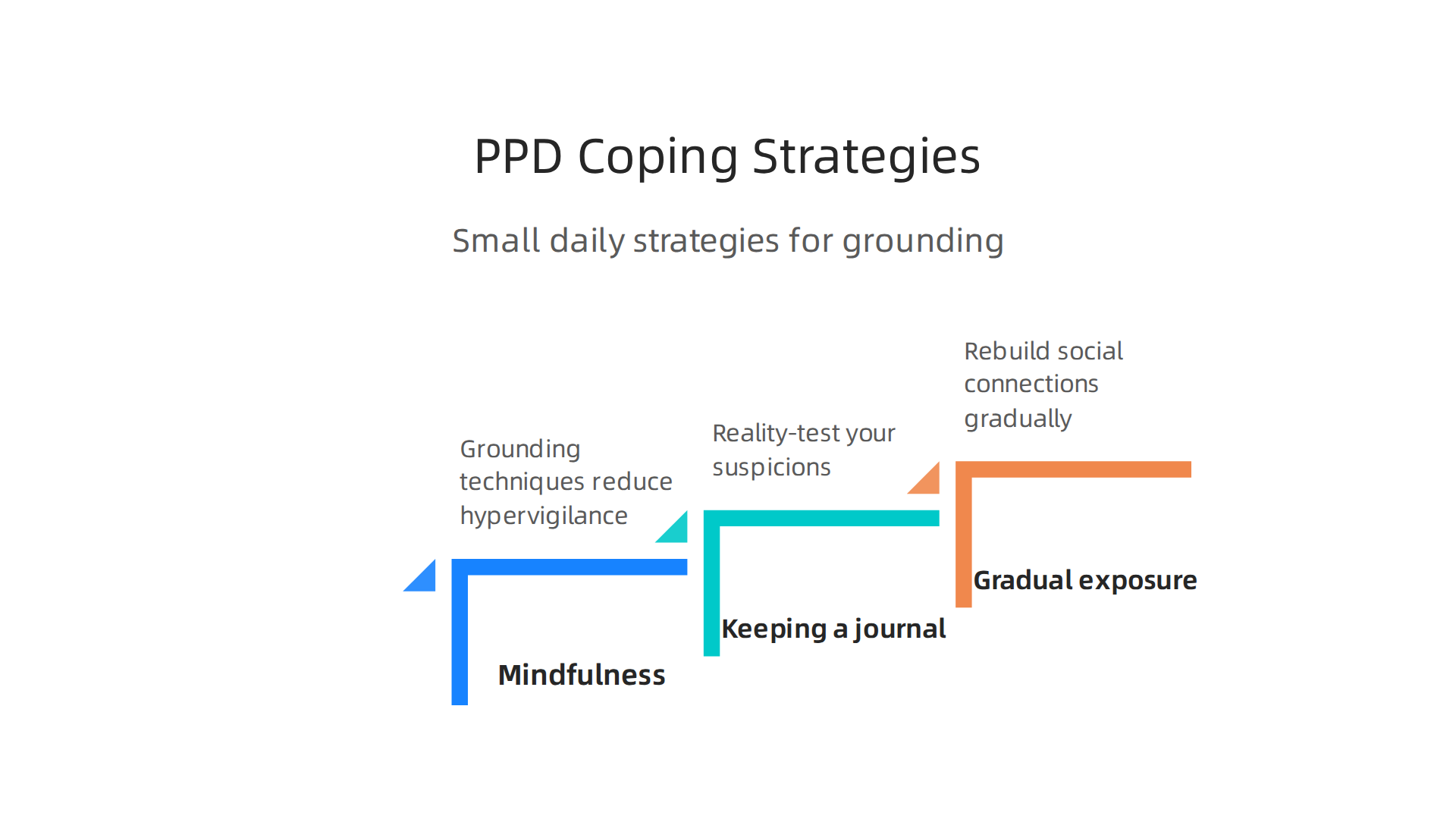
Mindfulness and grounding techniques are a direct way to lower hypervigilance. When you notice suspicious thoughts taking over, pause. Use your senses to connect with the present moment. Name five things you can see, four you can touch, three you can hear, two you can smell, and one you can taste. This simple exercise stops the worry loop. The StatPearls clinical review notes that structured reality testing is important for managing PPD, and grounding is a gentle first step.
Keeping a journal helps you reality-test your suspicions. Write down exactly what you are afraid of.

Then ask yourself: Is there solid evidence for this fear, or is my mind filling in the gaps? Paying close attention to your emotions (something that alexithymia can make much harder) is key here. Over time, journaling helps you spot patterns. For more structure, try building a step-by-step plan to manage anxiety.
Gradual exposure to trusted relationships can rebuild your social connections. Start very small. Maybe it is a five minute chat with a neighbor. Maybe it is a short coffee with a close friend. Do not rush. Let trust build at a pace that feels safe. Walden University points out that social isolation is a common struggle with PPD, but even tiny social wins make a real difference. If you want to understand the differences between PPD and conditions like delusional disorder or antisocial personality disorder symptoms, you can Define Anxiety Clearly to get simple definitions for complex mental health terms.
When to Seek Professional Help
But sometimes, coping on your own is not enough. If you notice red flags like cutting off all contact with others, losing jobs because of distrust, or having suicidal thoughts, it is time to get professional support. Social isolation is a serious sign that PPD is taking over your life Walden University.
A mental health professional will do a full assessment. They will look at your history, relationships, and how you test reality. As the Cleveland Clinic explains, getting a clear diagnosis often includes talking to a family member or friend who knows your patterns. This step separates paranoid personality disorder from similar conditions like delusional disorder or antisocial personality disorder symptoms. And if you struggle with alexithymia treatment, a therapist can help you name your feelings.
Early intervention makes a real difference. It can stop chronic disability and improve your everyday life. If depression is also present, exploring evidence-based therapy for depression can guide your next steps.
Need a simple way to understand all these mental health terms? Define Anxiety Clearly gives you clear, no-jargon definitions so you can take control of your knowledge.
Summary
This article explains paranoid personality disorder (PPD) in clear, practical terms: what it looks like, how common it is, and why it is often confused with other conditions like delusional disorder or schizophrenia. It reviews DSM-5 criteria, core symptoms such as pervasive mistrust and grudges, and common risk factors including genetics and childhood trauma. The guide walks through diagnostic challenges clinicians face, overlapping conditions and comorbidity, and why accurate diagnosis matters for treatment. Treatment-focused sections cover evidence-based psychotherapies (like CBT, mentalization and schema therapy), the limited role of medication, and supportive interventions such as psychoeducation and family work. The article finishes with everyday coping strategies to reduce hypervigilance, advice on when to seek professional help, and practical steps for supporting someone with PPD.