

Introduction
If you have ever felt like you have tried every treatment for depression without real relief, you are not alone.

Millions of people search for new answers every year. And lately, many of those eyes are turning to something different: non-invasive brain stimulation. You might have heard the term tms treatment for depression floating around in online forums, news articles, or conversations with your doctor. It sounds promising. But it can also feel overwhelming.
Here is the thing: there is a lot of noise out there. Between mentions of crash box therapy, questions about inpatient mental health facilities, and warnings about seroquel side effects, it is easy to lose sight of what actually works. You want real, clear information. You want to know what TMS is, how it works, and whether it might help you or someone you love.
That is exactly what this article delivers. We are going to cut through the confusion and give you a straightforward, evidence-based roadmap to understanding TMS. No jargon you cannot follow. No hype. Just the facts you need to make an informed decision.
Transcranial magnetic stimulation, or TMS, is a procedure that uses magnetic fields to stimulate nerve cells in the brain. It is approved by the U.S. Food and Drug Administration and is typically used when other depression treatments have not worked. You can read the Mayo Clinic’s overview of TMS therapy for a deeper dive into the basics.
But before we get into the details of how TMS changes brain activity, you might want to check your understanding of the conditions it treats. If you want a simple, clear starting point for mental health language, take a moment to Define Anxiety Clearly. Having that foundation makes everything else easier.
For a broader look at depression treatment options, you can also explore this guide on treatment for depression.
Now, let us move into the science of how TMS actually affects the brain.
What Is TMS Treatment for Depression?
Let’s start with a simple definition. Transcranial magnetic stimulation is a treatment that uses magnetic fields to wake up underactive parts of your brain.
Think of it like a gentle, targeted nudge to the neurons that help control your mood.
The full name sounds technical. But the concept is straightforward. A magnetic coil is placed against your scalp. That coil sends magnetic pulses through your skull and into your brain. These pulses create small electrical currents that stimulate nerve cells in a key area called the dorsolateral prefrontal cortex. This region is closely linked to mood regulation.
Why does that matter? In people with depression, this part of the brain often shows less activity. The magnetic pulses essentially tell those sleepy neurons to start firing again. When they do, they release more neurotransmitters like dopamine and serotonin. Those are the chemicals that help you feel motivated, focused, and emotionally stable.
This idea of using magnetic fields to influence brain activity is not new. But the specific way it targets the brain’s mood pathways is what makes it unique. The process is known as neuromodulation, and it works by changing how brain cells communicate with each other. A helpful resource on the underlying mechanisms of TMS explains that this stimulation can actually encourage neuroplasticity, which is your brain’s ability to form new, healthier connections over time.
The FDA Approval and Safety Timeline
The U.S. Food and Drug Administration first cleared TMS for major depression in 2008. Since then, the technology has evolved quickly. By 2026, there are multiple FDA-cleared protocols, including advanced versions like accelerated TMS and Deep TMS. These newer protocols can reduce the treatment time from weeks to just a few days while keeping the same safety profile.
One big reason TMS gained approval is its non-invasive nature. Unlike electroconvulsive therapy, TMS does not require anesthesia, sedation, or any surgical procedure. You stay awake the whole time. You can drive yourself home after each session. And the most common side effects are mild headaches or scalp discomfort, nothing like the serious side effects you might associate with some medications.
How TMS Is Different From Other Treatments
Here is where things get interesting. If you have looked into crash box therapy or wondered about inpatient mental health facilities, you already know that depression treatment comes in many forms. TMS is different because it works on the brain directly without changing your whole body’s chemistry.
Medications like antidepressants affect your entire system. They can bring unwanted seroquel side effects or other issues. Therapy requires you to talk through your experiences, which is helpful but can take a long time to change brain patterns. TMS sits somewhere in between. It uses science to target the physical source of the problem while still letting you continue your regular life.
Each TMS session lasts about 20 to 40 minutes. You sit in a comfortable chair. The coil is positioned on your head. You feel a tapping sensation on your scalp. And then you go about your day. There is no recovery time and no grogginess afterward.
If you want to explore other therapy options that work alongside TMS or on their own, you can read about cognitive behavior therapy for PTSD, which uses a different approach to change thought patterns and behavior.
Who Is TMS For?
TMS is typically recommended when at least one or two antidepressant medications have not worked well enough. That is called treatment-resistant depression. It is not a first-line treatment. But for people who have tried medication and therapy without full relief, TMS offers a completely different path forward that does not involve more pills.
The evidence is strong. A 2023 meta-analysis found that repetitive TMS had a large effect size over sham treatment for depression. In plain language, that means people who got real TMS showed significantly more improvement than those who received a placebo version of the treatment. You can look at the broader TMS research from 2026 to see how the evidence continues to grow for depression and other conditions.
So now you know what TMS is and how it works at the brain level. Next, we will look at what you can actually expect during a real TMS session and whether the results last over time.
How TMS Works: The Science Behind Magnetic Brain Stimulation
You already have a basic picture of how TMS uses magnetic fields to stimulate your brain. But what is really happening inside your neurons during those 20 to 40 minute sessions? Let’s break it down step by step.
The Physics of Magnetic Brain Stimulation
Every TMS session starts with a simple physical principle called electromagnetic induction. A special coil placed against your scalp creates a rapidly changing magnetic field. That magnetic field passes right through your skull and soft tissues without any pain. Once it reaches your brain’s outer layer, the cortex, it creates a small electrical current in the nearby neurons.
This is not magic. It is the same physics that powers electric generators and transformers. When the magnetic field changes direction quickly, it induces a tiny electric current in any conductor it passes through, and your brain tissue happens to be a good conductor. The electromagnetic induction mechanism of TMS explains exactly how this focused magnetic pulse turns into a targeted electrical signal inside your brain.
What Happens at the Neuron Level
When that electrical current reaches a group of neurons, it changes their electrical balance.
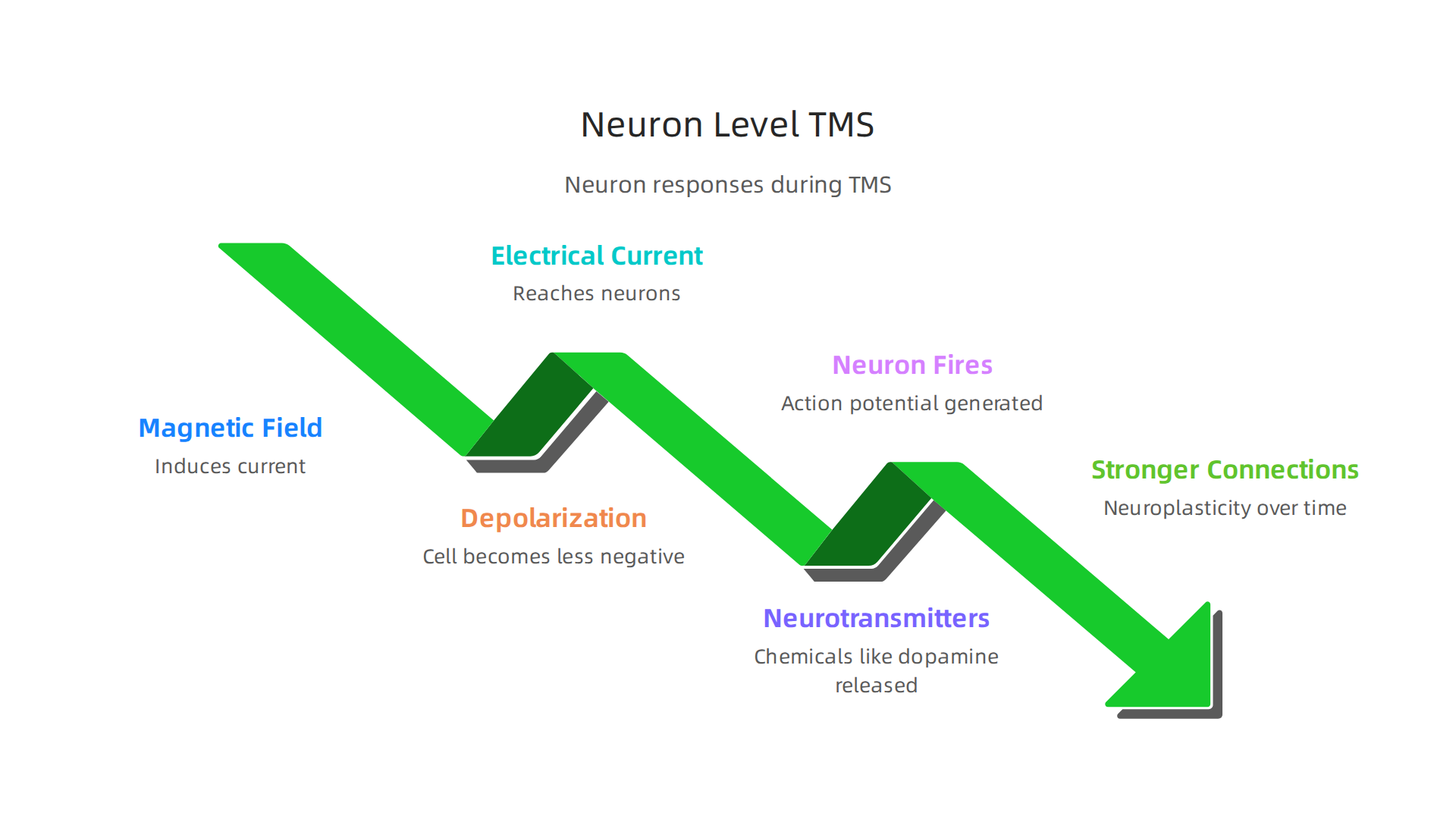
Think of each neuron as a tiny battery with a resting charge. The induced current makes the inside of the cell less negative, which is called depolarization. When that charge reaches a certain threshold, the neuron fires an action potential, basically a spike of electrical activity.
In TMS treatment for depression, the pulses are typically delivered at a high frequency, around 10 times per second. This high frequency actually increases the excitability of the neurons in the targeted area. In plain terms, it makes those sleepy brain cells wake up and start firing more often. And when they fire, they release more of the mood boosting chemicals like dopamine and serotonin that help regulate your emotions.
Building Lasting Change Through Neuroplasticity
Here is where the science gets really interesting. The immediate effects of a single TMS session may last only a few hours. But when you repeat the stimulation day after day, something deeper happens. Your brain starts to rewire itself.
This process is called long term potentiation, or LTP for short. It is a well studied form of neuroplasticity where connections between neurons become stronger and more efficient the more they are used. Think of it like a footpath in a forest. The more people walk that path, the clearer and easier it becomes to follow. TMS essentially walks that path over and over until your brain creates a new, healthier route for mood regulation.
The reason TMS can produce lasting results even after the treatment ends is because it triggers these plastic changes in your brain networks. Your neurons literally grow stronger connections with each other. This is similar to how counseling rewires the brain for anxiety, using consistent practice to change neural pathways over time.
The Dorsolateral Prefrontal Cortex Connection
The stimulation is not random. It targets a specific brain region called the dorsolateral prefrontal cortex, or DLPFC. This area sits just behind your forehead and plays a critical role in mood regulation, decision making, and emotional control. In people with depression, the DLPFC often shows lower activity levels.
By repeatedly activating this region with magnetic pulses, TMS helps restore normal communication between the DLPFC and deeper brain structures like the amygdala and the anterior cingulate cortex. These areas work together to process emotions and respond to stress. When that communication is working well, your mood naturally improves.
Now that you understand the science behind the stimulation, you are ready to learn what a real TMS session feels like and how long the benefits typically last.
Who Is a Candidate for TMS? Eligibility and Success Rates
TMS is not for everyone with depression. Doctors carefully screen each person to decide if TMS makes sense. The treatment is mostly used for what is called treatment-resistant depression. That means you have tried at least one antidepressant medication at a full dose for a long enough time, and it did not work well enough.
Standard Eligibility Requirements
Most insurance companies and clinics follow similar rules. You need a confirmed diagnosis of major depressive disorder, and your depression must be at least moderately severe. You also need to show that you have failed one or more antidepressant trials. Some plans require proof that you tried therapy too. The deep TMS eligibility criteria from BrainsWay list what insurance typically wants, including the specific diagnosis codes and documentation of past treatments.
You usually must be between 18 and 65 years old, though some clinics treat older adults. You also need to be free of certain health conditions that could make TMS unsafe. These include any metal objects in your head, a history of seizures, or an active psychotic disorder.
What the Numbers Say About Success
The success rates for TMS are encouraging but not perfect. Around 50 to 60 percent of people who try TMS see a significant drop in their depression symptoms. About 30 to 40 percent achieve full remission, meaning their symptoms disappear almost completely. According to the CMS Medicare coverage guidelines for TMS, studies showed a 57 percent average reduction in depression scores, with 46 percent of patients responding and 31 percent reaching remission.
These numbers might sound modest, but they are impressive for people who have already tried multiple medications without success. For many, TMS becomes the treatment that finally works.
Who Should Not Try TMS
Some people are not good candidates for TMS. Safety reasons are the most common. You cannot have TMS if you have metal implants in your head, like aneurysm clips or bullet fragments. People with a seizure disorder or a history of epilepsy are usually excluded. The same goes for anyone with active suicidal thoughts or psychosis. Pregnant women are also advised to avoid TMS unless the benefits clearly outweigh the risks.
Doctors also look at what might predict a better response. People who responded well to TMS in the past are more likely to succeed again. Those without complicated psychiatric conditions, like bipolar disorder or substance abuse, also tend to do better.
If you think you might be a candidate, talk to a psychiatrist who offers TMS. They can review your history and run any needed tests. And if you are looking for other options that pair well with TMS, exploring treatment for depression can give you a full picture of what is available.
Comparing TMS to Other Advanced Therapies: Ketamine, ECT, and More
If you have treatment-resistant depression, you may have heard about other advanced options besides TMS. Ketamine infusions, electroconvulsive therapy (ECT), and newer forms of TMS like deep TMS all offer hope. But each works differently, and the right choice depends on your situation.
Let’s break down how they compare.
How Fast Do They Work?
Ketamine is the speed champion. It can lift depression within hours or days. That makes it a great option for people in crisis. But the effects are short-lived, often wearing off in about a week. You usually need ongoing maintenance treatments.
ECT also works fairly quickly, with most people feeling better within one to two weeks. ECT is considered the gold standard for severe depression because it produces the most consistent results. However, it requires general anesthesia and a short hospital stay.
TMS takes longer. Most people start noticing changes after two to four weeks of daily sessions. But the benefits tend to last. Many people stay well for months or even a full year after finishing a course of TMS.
Which One Is More Effective?
It depends on how you measure success. A 2025 comparison of TMS, ketamine, and ECT found that all three are effective, but they shine in different ways. According to the Ketamine vs TMS vs ECT for Depression guide, ECT achieves the most powerful outcomes for severe depression, with around 48 percent reaching full remission. Ketamine has a response rate of 50 to 70 percent, and TMS sits at about 50 to 60 percent response with 30 to 40 percent remission.
Newer TMS methods, like deep TMS and accelerated TMS, are improving those numbers. Some studies show remission rates as high as 70 to 79 percent with personalized fMRI-guided TMS.
Side Effects Matter a Lot
This is where the differences really show up.
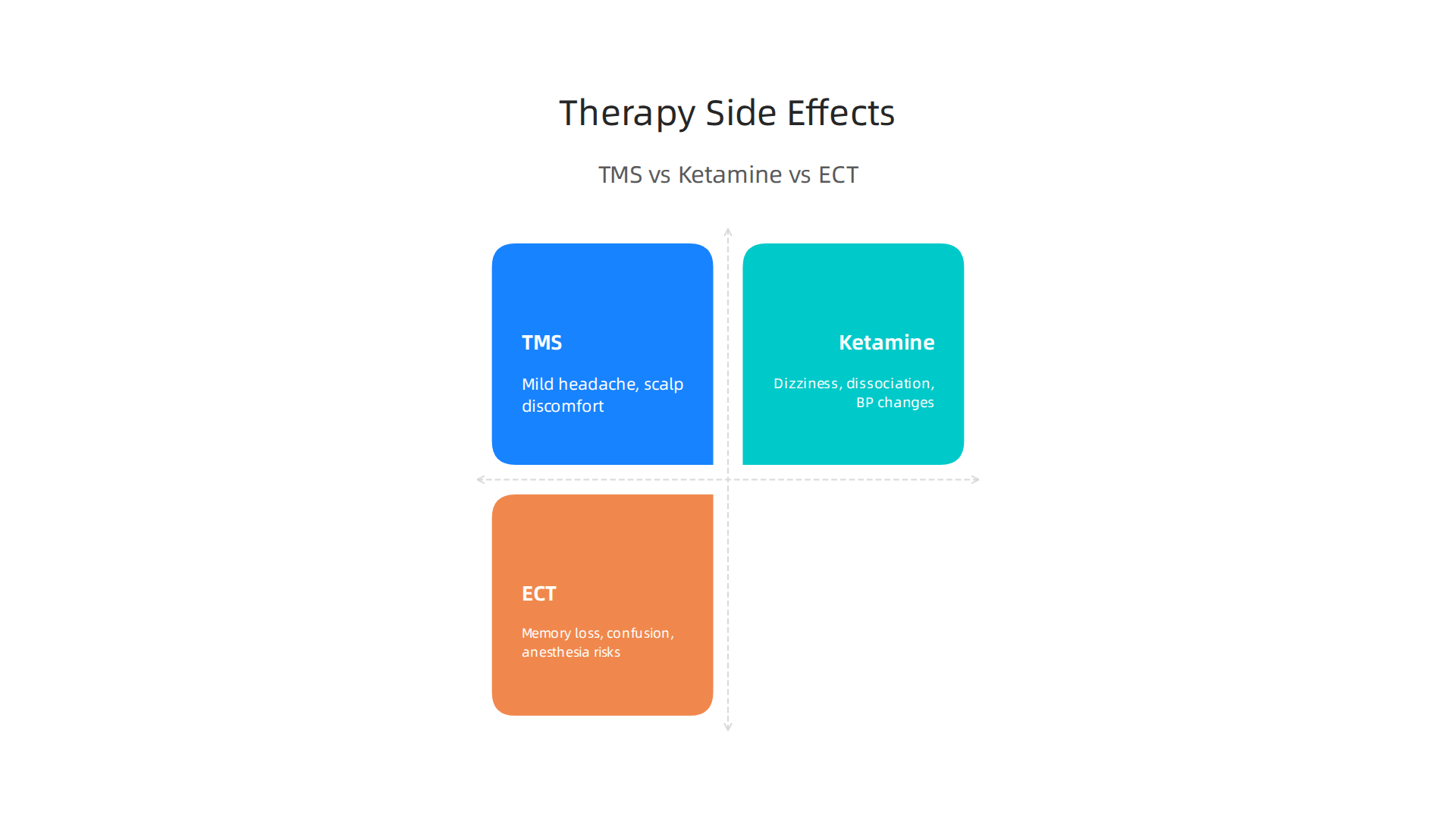
- TMS side effects are mild. The most common issue is a headache or scalp discomfort during or right after a session. No sedation, no memory loss, and no time off work.
- Ketamine side effects can include dizziness, nausea, and a brief feeling of being disconnected from your body. These wear off within hours, but you need to be monitored at a clinic and cannot drive afterward.
- ECT side effects are the most serious. Short-term confusion and memory gaps are common. About 10 percent of people have lasting memory problems. The use of general anesthesia also carries its own small risks.
Because of this, many people prefer TMS as a first choice among these advanced therapies. If you are still deciding, it helps to understand what each treatment actually feels like. You can read more in this guide to ketamine side effects for anxiety to see if that route fits you.
Access and Convenience
TMS requires daily visits for four to six weeks. Each session lasts about 20 to 40 minutes, and you can go back to work or normal life right after. Ketamine infusions also need repeated visits, usually twice a week for several weeks, and you need someone to drive you home. ECT is the most intensive, often requiring two to three sessions per week in a hospital setting, with anesthesia recovery each time.
A Quick Comparison Table
| Therapy | Typical Response Rate | How Fast It Works | Main Side Effects |
|---|---|---|---|
| TMS | 50–60% | 2–4 weeks | Mild headache, scalp discomfort |
| Ketamine | 50–70% | Hours to days | Dizziness, dissociation, blood pressure changes |
| ECT | ~48% remission | 1–2 weeks | Memory loss, confusion, anesthesia risks |
Which One Should You Consider?
There is no single best answer. If you need fast relief, ketamine might be your starting point. If your depression is very severe or you have not responded to anything else, ECT remains the most powerful tool. But if you want a safe, noninvasive option with lasting results and few side effects, TMS is a strong choice.

Think about your goals, your tolerance for side effects, and your schedule. Many people also combine these treatments with therapy or lifestyle changes. For a deeper look at how reinforcement systems shape mental health outcomes, check out the canonical field note on the Value Reinforcement System. It offers a fresh way to think about recovery.
The TMS Treatment Process: What to Expect from Start to Finish
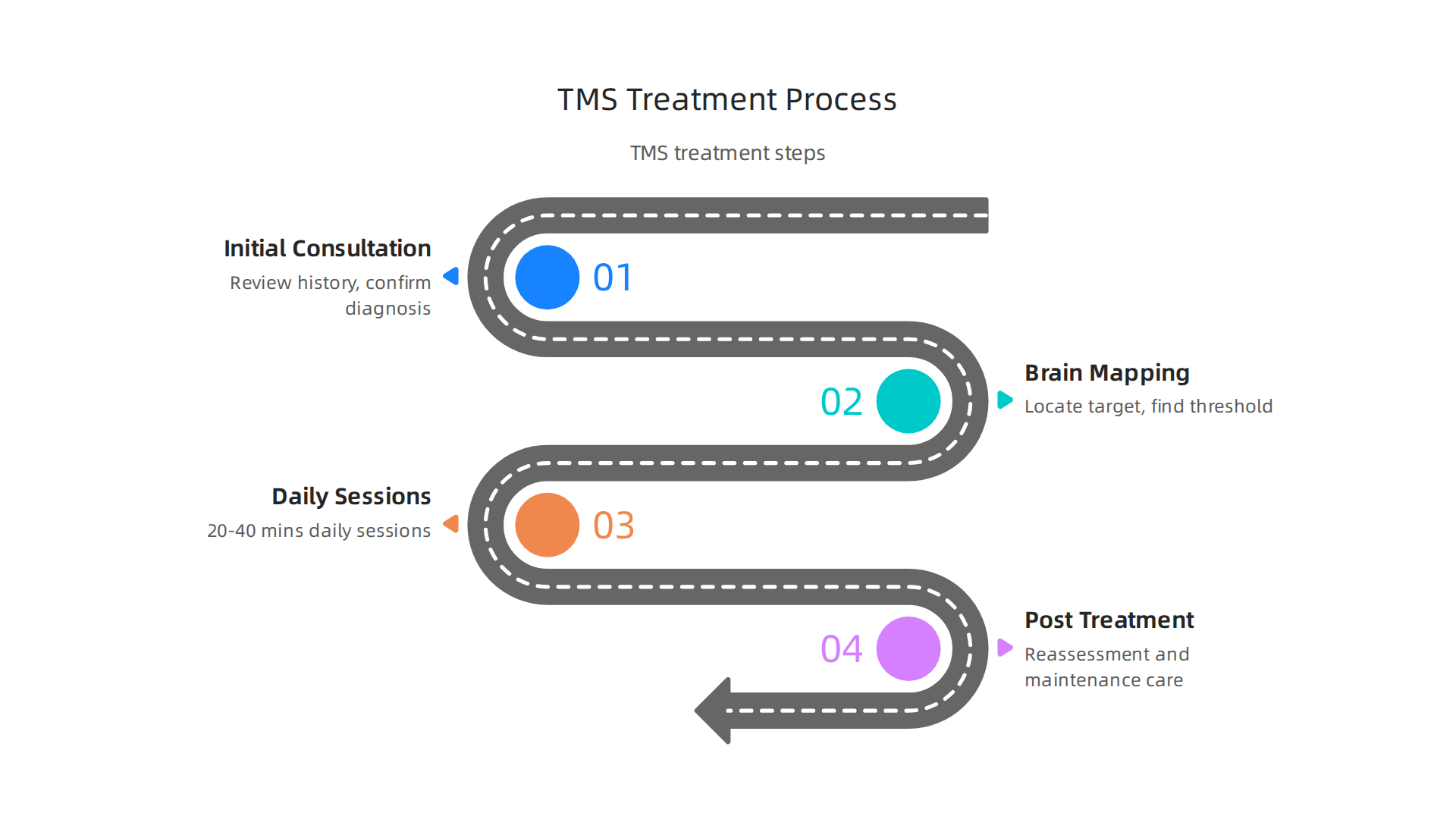
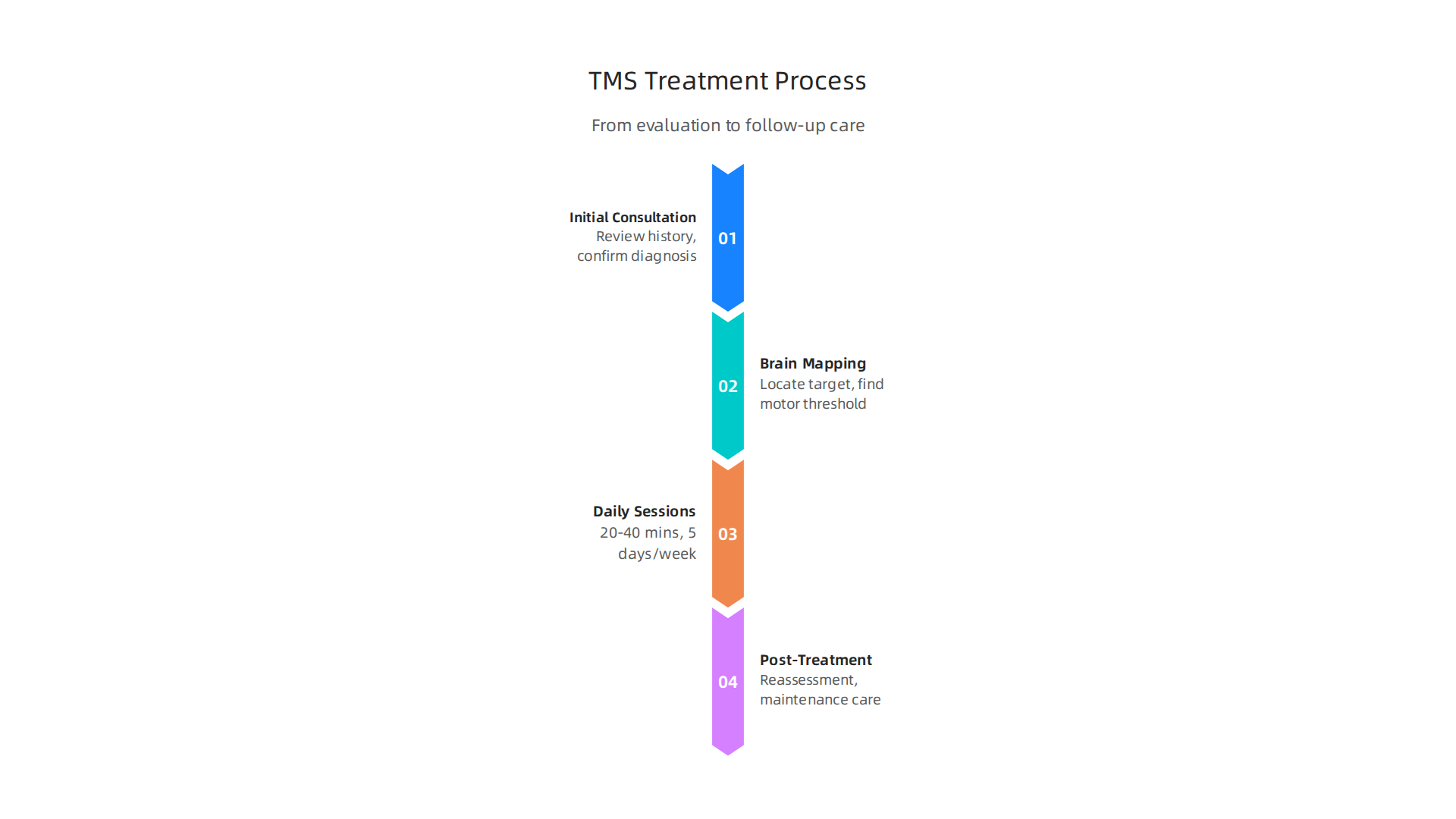
So you are considering TMS treatment for depression. That is a big step, and knowing exactly what happens can take away a lot of the fear. The process is more straightforward than you might think. It involves a few clear stages: an evaluation, brain mapping, a series of daily sessions, and some follow-up care.
Here is what each part looks like.
Step 1: The Initial Consultation
Before the first pulse, you meet with a TMS provider. They review your medical history, current medications, and past depression treatments. TMS is usually offered to people who have not gotten better after trying at least one antidepressant medication. Insurance plans often require that you have tried a certain number of medications first. For example, the CMS coverage guidelines for TMS state that you must have failed one or more trials of antidepressants or shown an intolerance to them. That check ensures TMS is the right move for you.
The doctor also makes sure you do not have any conditions that make TMS unsafe. Things like metal implants in the head, a history of seizures, or active psychosis usually rule out TMS. You fill out a depression rating scale, like the PHQ-9, to get a baseline score. This helps track your progress later.
Step 2: Brain Mapping (Neuronavigation)
Once you are cleared, the next step is brain mapping. This is a fancy name for a short process where the provider finds the exact spot on your scalp that sits above the part of your brain linked to depression. That area is typically the left dorsolateral prefrontal cortex. The provider uses a technique called neuronavigation, which might involve a cap with markings or a quick MRI scan. They measure the "motor threshold" by giving a tiny pulse to find the minimum energy needed to make your thumb twitch. That tells them the right dose for your treatments.
This step takes about 30 minutes on your first visit. After that, every session uses the same settings, so no repeat mapping is needed.
Step 3: The Daily Sessions
Here comes the routine. Most TMS treatment for depression involves daily sessions, five days a week, for four to six weeks. Each session lasts 20 to 40 minutes, depending on the type of TMS used. Standard rTMS takes about 37 minutes, while newer iTBS takes only about 3 to 5 minutes per session. Your provider will choose the best protocol for you.
During a session, you sit in a comfortable chair. The provider places the magnetic coil against your scalp at the mapped spot. You hear a clicking sound and feel a tapping sensation on your head.

That is the magnetic pulse. You can watch TV, listen to a podcast, or just relax. There is no pain for most people, though some get a mild headache afterward, which usually goes away quickly. You are awake and alert the whole time. No driving restrictions.
Step 4: Post-Treatment Follow-Up and Maintenance
After you finish the initial course, your doctor will reassess your depression scores. Many people notice significant improvement. But depression can return over time. That is why some providers offer maintenance TMS. This means you come in for a TMS session once a month or once every few weeks to keep the benefits going. More research is being done on the best maintenance schedules, but early results are promising.
You can also combine TMS with ongoing therapy or lifestyle changes to protect your progress. If you want to learn more about combining treatments, check out this guide on treatment for depression. It walks through different therapy options that can support your recovery after TMS.
The whole TMS process is designed to fit into your normal life. You go to a clinic, get the treatment, and go back to work or school. No anesthesia, no memory loss, no downtime. For many people, that convenience makes all the difference.
Navigating the Journey: Finding a Provider and Insurance Coverage
Figuring out where to get TMS and how to pay for it can feel like a second job.

But it does not have to be hard. Here is a simple breakdown.
Start your search by looking for TMS clinics through professional groups like the Clinical TMS Society. Their website lists approved providers who follow proven safety standards. You can also search online reviews and ask your regular doctor or psychiatrist for referrals. Ask about the device they use, like NeuroStar or MagVenture, and how many treatments they have performed. Many clinics offer a free consultation call so you can ask questions before committing.
Insurance coverage for TMS is common but not automatic. Most private plans, including BlueCross, Aetna, Cigna, UnitedHealthcare, and Medicare, cover TMS for major depressive disorder. However, they usually require that you have tried at least two antidepressant medications without success. Some insurers, like Optum, recently changed their rules to require only two failed trials instead of four. For a quick overview of what different plans require, check out this clear guide to TMS insurance requirements. It walks through the eligibility criteria for each major carrier.
Without insurance, a full course of TMS costs between $6,000 and $15,000. With insurance, your out-of-pocket cost is much lower, usually $500 to $3,000 depending on your copay and deductible. For a detailed breakdown by plan type, refer to this complete guide to TMS pricing in 2026. It explains deductibles, coinsurance, and typical copays.
If you do not have insurance or have a high deductible plan, ask the clinic about financial assistance. Many clinics offer payment plans, sliding scale fees, or cash-pay discounts. Some non-profit organizations also provide grants for depression treatment. Never be afraid to ask about cost before starting.
While TMS can relieve depression symptoms, many people benefit from adding therapy afterward to build long-term coping skills. If you want to learn about therapy options, read this guide on clinical mental health counseling for anxiety. It explains how counseling can rewire your brain to reduce symptoms over time.
The Future of TMS and Alternative Depression Therapies
TMS treatment for depression is changing fast. The clinics you visit today might look very different just a few years from now. Here is what is on the horizon.
The biggest shift is towards faster treatment. Standard TMS takes six weeks. New accelerated protocols compress that into days. The BrainsWay SWIFT protocol, for example, reduces clinic visits by 70% compared to standard treatment. Early results are striking. According to recent SWIFT protocol durability data, over 80% of patients remained in remission through 12 months. That is a big leap from older protocols.
Another approach is fMRI-guided accelerated TMS, sometimes called SAINT-style treatment. Instead of six weeks, it delivers multiple sessions each day for just five days. Research shows remission rates around 50% in controlled trials. Some open-label studies report even higher numbers. The key here is personalization. Doctors image your brain first, then target the exact spot that needs stimulation. No guesswork.
Deep TMS is also advancing. It uses a different coil called an H-coil to reach broader brain regions. This matters for people who do not respond to standard TMS. Deep TMS is already FDA-approved for depression and OCD, and research continues into other conditions.
What about combining TMS with other treatments? Many clinics now integrate TMS with psychotherapy or digital tools. The idea is simple. TMS changes brain activity, and therapy helps you build new habits on top of that change. If you are curious how these approaches connect, this guide on clinical mental health counseling for anxiety explains how counseling can reinforce the rewiring that TMS starts.
Researchers are also studying personalized stimulation parameters. Instead of one-size-fits-all dosing, future TMS may adjust based on your brain’s unique electrical patterns. Electroencephalogram (EEG) and MRI data could help doctors fine-tune the treatment in real time.
For people who do not respond to TMS, other options exist. Ketamine therapy works within hours instead of weeks. Electroconvulsive therapy (ECT) remains the gold standard for severe cases. Some research even explores psilocybin for treatment-resistant depression. According to a 2026 research roundup on TMS, ongoing studies are expanding TMS into new areas like suicidality, addiction, and neurodegenerative diseases.
The bottom line? TMS is getting faster, smarter, and more personalized. If standard TMS did not work for you or felt too time-consuming, check back in with your provider. The options keep improving.
Summary
This article explains transcranial magnetic stimulation (TMS) as a noninvasive, FDA-cleared treatment for people whose depression has not improved with medications or therapy. It covers how magnetic pulses target the dorsolateral prefrontal cortex to increase neural activity and encourage neuroplasticity, why repeated sessions produce lasting change, and what a typical course looks like (daily sessions for several weeks with short, awake visits). You will learn who is eligible, common success rates (about 50–60% response and 30–40% remission in many studies), typical side effects (mild headache or scalp discomfort), and key exclusions like seizure history or metal implants. The guide compares TMS with ketamine and ECT on speed, effectiveness and side effects, walks through insurance and cost considerations, and describes newer accelerated and deep-TMS options that boost convenience and outcomes. By reading this, you should be able to decide whether to discuss TMS with your clinician, know what questions to ask a provider, and understand practical next steps for pursuing treatment.