

Introduction
Have you ever felt like your home is suffocating under piles of things?

Or have you experienced weeks of sky high energy followed by deep lows that make no sense? These struggles often point to hoarding disorder and cyclothymia, two chronic conditions that are widely misunderstood. Many people think hoarding is just being messy, and cyclothia is just being moody. But both are serious mental health issues that disrupt your daily life, work, and relationships.
The good news is that effective hoarding disorder treatment exists. It goes beyond simply clearing out your space. Therapy helps you understand the emotional reasons behind your attachment to objects, and teaches you practical ways to let go. Cyclothymia treatment focuses on stabilizing your mood so the highs and lows stop controlling you. If you want a deeper look at mood disorders, check out our guide on bipolar treatment options for medications and lifestyle strategies.
In this article, we cover evidence based approaches for both conditions. We also touch on narcissistic personality disorder treatment and cognitive behavioral therapy for intermittent explosive disorder. Early and accurate treatment can dramatically improve your quality of life. When you know what you’re dealing with, you can find the right kind of help.
If you are ready to start, begin by understanding the basics. Define Anxiety Clearly helps you cut through confusing mental health jargon and gives you a solid foundation for your journey.
Now let’s explore which treatments really work.
Understanding Hoarding Disorder and Cyclothymia
Let’s take a closer look at what these two conditions actually are. Knowing the facts is the first real step toward getting the right help.
Hoarding disorder is a recognized mental health condition in the DSM-5. It is defined by a persistent difficulty getting rid of possessions, no matter what they are worth. The American Psychiatric Association reports that about 2.6% of people have this condition, so it is much more common than most people realize. This is not about being messy or lazy. The struggle is real and it causes major distress. Over time, clutter takes over living spaces and makes daily life very hard. While hoarding used to be seen as a type of OCD, it is now its own diagnosis. However, according to Theravive, about 20% of people with hoarding disorder also have OCD. If you are dealing with severe clutter, it can help to learn more about related conditions in our OCD medication guide.
Cyclothymia, or cyclothymic disorder, is like a milder but longer lasting version of bipolar disorder. People with cyclothymia have frequent mood swings. They go through periods of hypomania, where they feel super energetic and wired, and periods of mild depression where they feel low. Because these shifts are not as extreme as full bipolar disorder, people often write it off as being "dramatic" or just "moody." This is why cyclothymia is so often missed by doctors. For a closer look at how mood disorders differ and how they are treated, check out our guide on bipolar treatment options.
Both conditions share a key problem. They are frequently underdiagnosed, and they often show up alongside anxiety disorders. This makes getting a clear diagnosis very important.
The best thing you can do is cut through the confusion. When you have a clear name for what is happening, you can take the next step. If you are trying to make sense of these terms, it helps to have a reliable resource. Define Anxiety Clearly helps you build a solid foundation of mental health knowledge so you can approach treatment with confidence.
Next, we will break down the specific hoarding disorder treatment approaches that actually help people reclaim their space and their peace of mind.
Why Early Recognition Matters
You already know these conditions fly under the radar for years. That is the real problem. The longer they go unnoticed, the more damage they do. Your living space shrinks. Your relationships suffer. Your confidence takes a hit.
But here is the thing. When you catch the signs early, everything changes.
Hoarding disorder treatment works much better when it starts before the clutter takes over completely. The American Psychiatric Association makes this point very clear. They say early recognition, diagnosis, and treatment are crucial to improving outcomes. The same is true for cyclothymia treatment. Mood swings that get addressed early are easier to stabilize. You avoid years of being told you are just "dramatic" or "moody."
Think about who usually notices first. It is not the person struggling. It is the family and friends. They watch the rooms fill up. They see the energy spikes and crashes.

But they do not speak up. Maybe they feel it is not their place. Maybe they think it is just a phase.
According to Psychology Today, about 1 in every 40 adults deals with serious hoarding behaviors. That is not rare. That is common. Yet most people suffer in silence for years before getting help.
So how do you know if it is time to act? Doctors use the DSM-5 criteria to make a clear diagnosis. They look at specific patterns. Do you struggle to throw things away, even worthless items? Does the clutter stop you from using your kitchen, your bedroom, or your bathroom? These are real red flags.
You can also do your own check-in. Ask yourself some honest questions. Do you avoid having people over? Do you feel panicked at the thought of discarding something? If the answer is yes, it is time to pay attention. And if you also deal with anxiety alongside these symptoms, it helps to have strong coping skills for anxiety in your back pocket.
The goal is simple. Move from guessing to knowing. You cannot fix a problem when you do not know its name. That confusion keeps people stuck for years.
Define Anxiety Clearly helps you cut through the noise. It gives you a solid foundation of mental health knowledge so you can name what is happening and take the first real step forward.
When you recognize the signs early, you have more options. The next step is understanding what hoarding disorder treatment actually looks like and how it can help you reclaim your space. Let us break it down.
Cognitive Behavioral Therapy (CBT) for Hoarding
Now you know what to look for. So what happens next? The most proven path forward is cognitive behavioral therapy (CBT). Think of it as the gold standard for hoarding disorder treatment. The Mayo Clinic calls CBT the main treatment for hoarding, and the American Psychiatric Association agrees that therapy can help people declutter and live safer lives.
But what makes CBT different from just talking about your feelings? It is a skills-based approach. You do not just discuss why you keep things. You learn how to change the thoughts and actions that drive the behavior.

Here is how it works in practice. CBT for hoarding has three core parts.
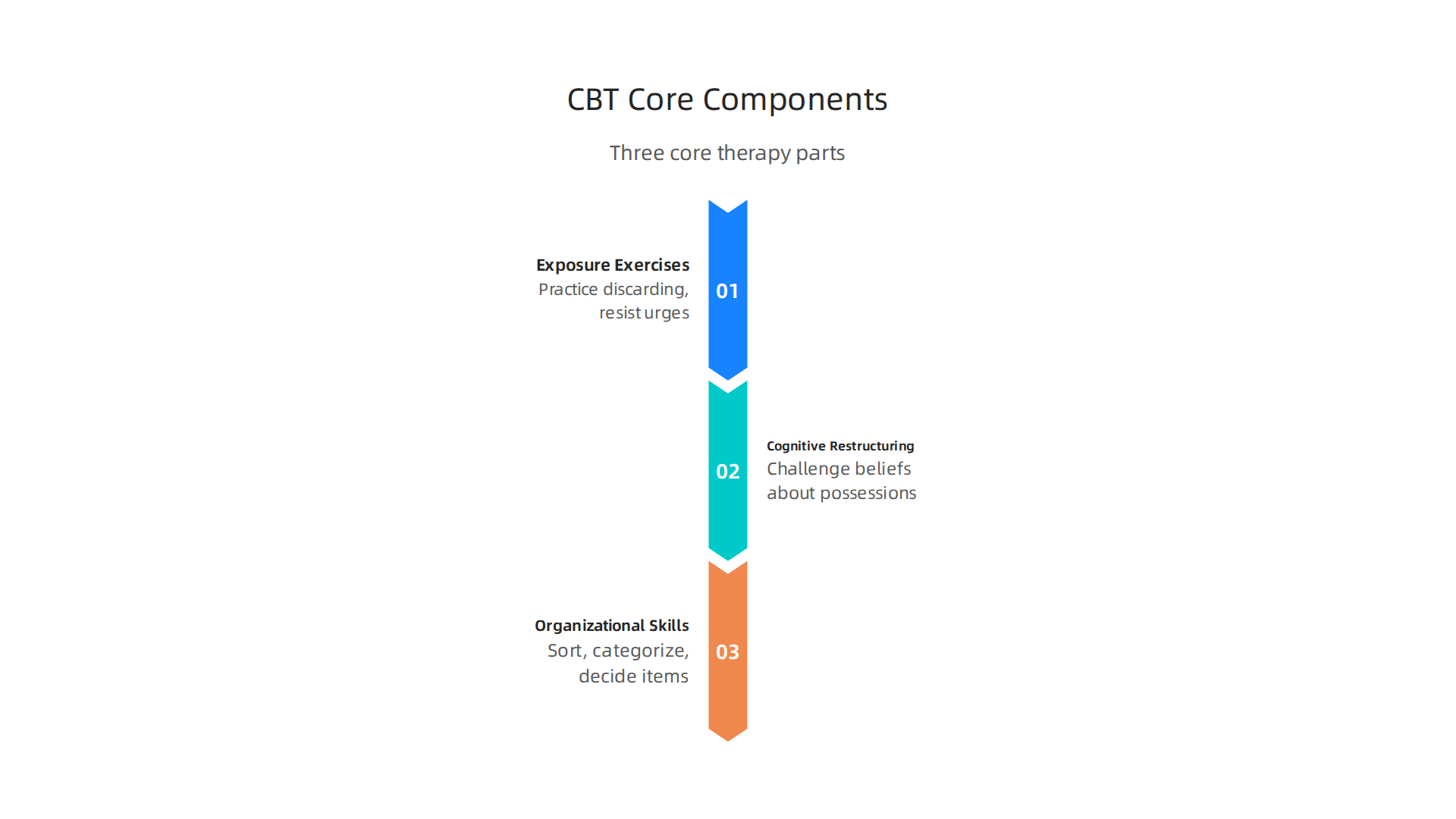
Exposure exercises. This is the hard part. You practice throwing things away or resisting the urge to pick up free items. It feels uncomfortable at first. That is the point. Over time, the anxiety drops. The International OCD Foundation reports that 70 to 80 percent of people who complete CBT for hoarding are much or very much improved after 9 to 12 months.
Cognitive restructuring. Your brain tells you stories about your stuff. "I might need this someday." "This reminds me of Mom." "Without this, I will feel empty." CBT helps you challenge those stories. You learn to separate sentimental value from real value. You stop treating every item like an emergency.
Organizational skills training. This is the practical side. You learn how to sort, categorize, and decide what stays and what goes. You build systems that actually work for your life. It is not about becoming a minimalist. It is about creating space you can use.
One more thing matters a lot. Home visits and family involvement make CBT stronger. When a therapist comes to your actual space, they see the real picture. And when family members learn how to help without shaming, progress sticks better. The research backs this up. A 2024 systematic review found that CBT leads to reliable change with a large effect size.
CBT also works for other conditions that often overlap with hoarding, like bipolar mood swings or anxiety disorders. If you also struggle with depression, it helps to explore bipolar treatment options that use similar therapy methods.
The bottom line is simple. CBT gives you real tools, not just good intentions. It teaches your brain a new way to relate to your belongings. And that changes everything.
Before you start any therapy, it helps to understand the basics. Define Anxiety Clearly gives you the simple, reliable foundation you need to move forward with confidence. No jargon, no confusion. Just clear answers so you know what you are working with.
Other Psychotherapeutic Approaches
CBT is a powerful tool, but it is not the only path forward. Many people with hoarding disorder also live with other conditions. Things like mood swings, emotional explosions, or deep shame. That is where other therapy styles come in. They can treat the whole picture, not just the clutter.
Let us look at a few approaches that work well alongside or instead of CBT.
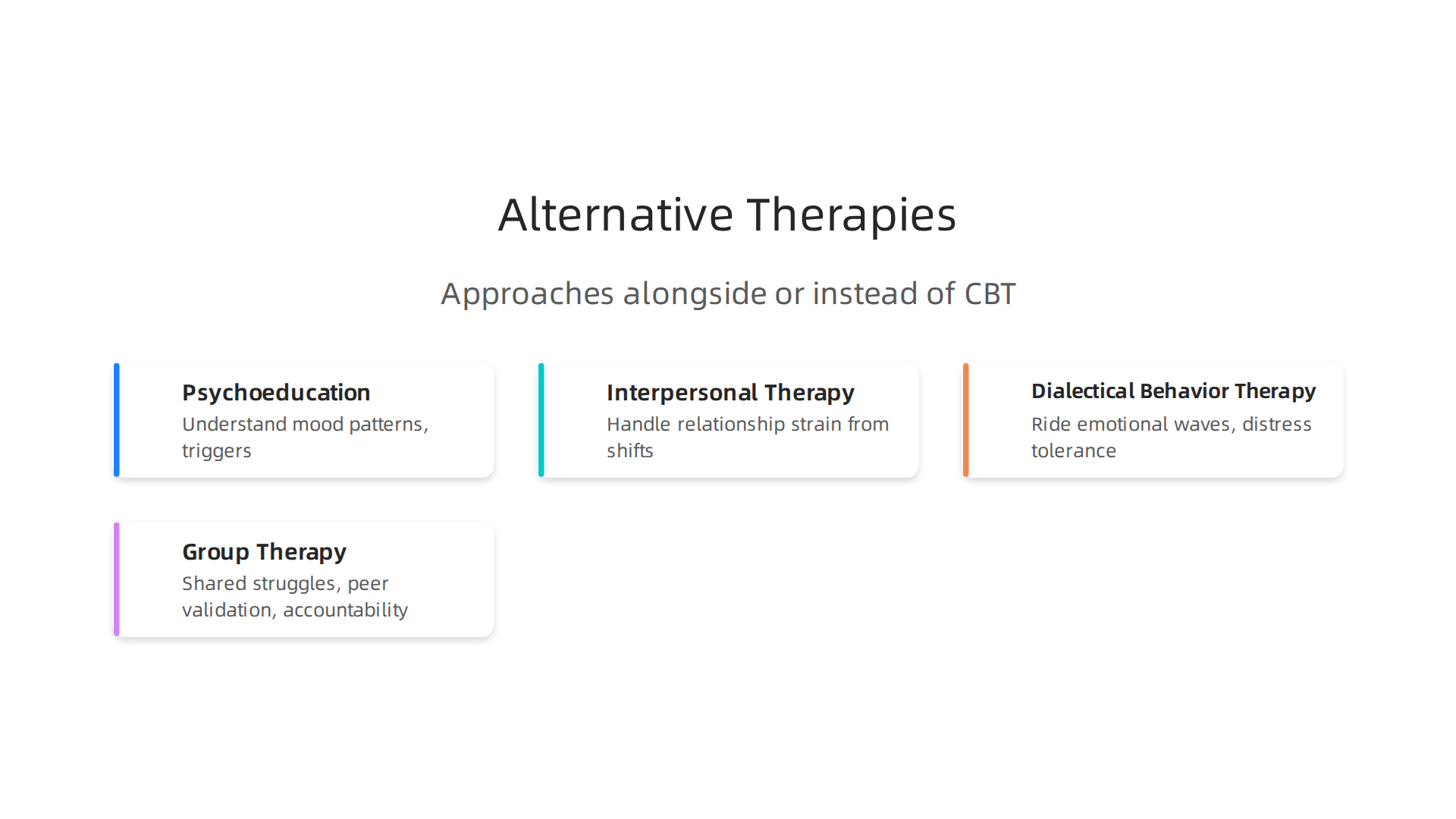
Psychoeducation and interpersonal therapy for cyclothymia. Cyclothymia is a milder form of bipolar disorder. You have ups and downs, but they are less extreme than full mania or depression. If you have both hoarding and cyclothymia, treatment needs to address both. Psychoeducation helps you understand your mood patterns. You learn what triggers the highs and lows. Interpersonal therapy then helps you handle the relationship strain these mood shifts cause. If this sounds familiar, exploring bipolar treatment options that include these methods can give you a clearer path forward.
Dialectical Behavior Therapy (DBT) for emotional dysregulation. DBT was originally designed for borderline personality disorder, but its core skills work for many conditions. When you hoard, the urge to acquire or save things often comes from intense emotions. DBT teaches you how to ride those waves without acting on them. It helps with distress tolerance and emotional regulation. These skills also help with intermittent explosive disorder, where anger bursts can derail progress. If managing anger is part of your struggle, check out anger management therapy that uses similar DBT techniques.
Group therapy and support groups. You are not alone in this. Groups provide a space where people truly get it. You hear others share the same struggles. You celebrate small wins together. That peer validation is powerful. It also creates accountability. When you know you will see the group next week, you are more likely to follow through on decluttering tasks. A 2024 systematic review found that psychosocial interventions, which include group formats, lead to reliable improvement for hoarding disorder. Groups also help with narcissistic personality disorder traits by teaching empathy and shared responsibility.
Before you start any therapy, it helps to know exactly what you are dealing with. Define Anxiety Clearly gives you simple, trustworthy explanations of mental health terms and conditions. No confusion, just the basics you need to take the next step.
Pharmacological Treatments and Considerations
You have learned about talk therapies for hoarding disorder. But what about medication? Maybe you have wondered if a pill could help you let go of things more easily. The short answer is: medication can help some people, but it works best when paired with therapy.
Let us start with hoarding disorder itself. Right now, no medications are officially approved just for hoarding disorder. The Mayo Clinic and other experts confirm that cognitive behavioral therapy is the first-line treatment. But doctors often prescribe medications used for related conditions. The most common choice is a class of drugs called SSRIs. These are selective serotonin reuptake inhibitors. You may know them as antidepressants like Prozac, Zoloft, or Lexapro. Research from the International OCD Foundation shows that SSRIs have modest evidence for hoarding symptoms. Some small studies, including a trial on venlafaxine, have shown improvement. But the results are not strong enough to recommend medication alone. That is why most experts say: use medication alongside CBT, not instead of it.
Now, if you also have cyclothymia, the picture changes. Cyclothymia is a milder form of bipolar disorder. For that, doctors typically prescribe mood stabilizers like lithium or lamotrigine. These medications help prevent the mood swings that can make hoarding worse. If you suspect cyclothymia, you need a proper evaluation. Exploring bipolar treatment options that include mood stabilizers can give you a clearer path forward.
Here is the thing about any medication: you have to take it consistently. Skipping doses or stopping too early can cause problems. SSRIs can take weeks to work. Side effects like nausea, sleep changes, or sexual issues can happen. Mood stabilizers require regular blood tests to check levels. That is why medication adherence and side effect monitoring are critical. You need a doctor who listens and adjusts as needed.
If you are already taking medication for anxiety or OCD, you might find that similar drugs are tried for hoarding. For more on that, check out this OCD medication guide to understand how these medicines work.
Before you talk to a doctor about any of these options, it helps to understand the basic terms. What is an SSRI? What is a mood stabilizer? Do not get lost in medical jargon. Define Anxiety Clearly gives you simple, trustworthy explanations of these medications and more. No confusion, just the basics you need to take the next step.
Integrated Treatment Strategies and Lifestyle Support
So you know about talk therapy and medication. But here is the real secret to lasting change. The best results come when you combine psychotherapy, medication, and healthy lifestyle habits all at once. That is what experts now call an integrated approach.
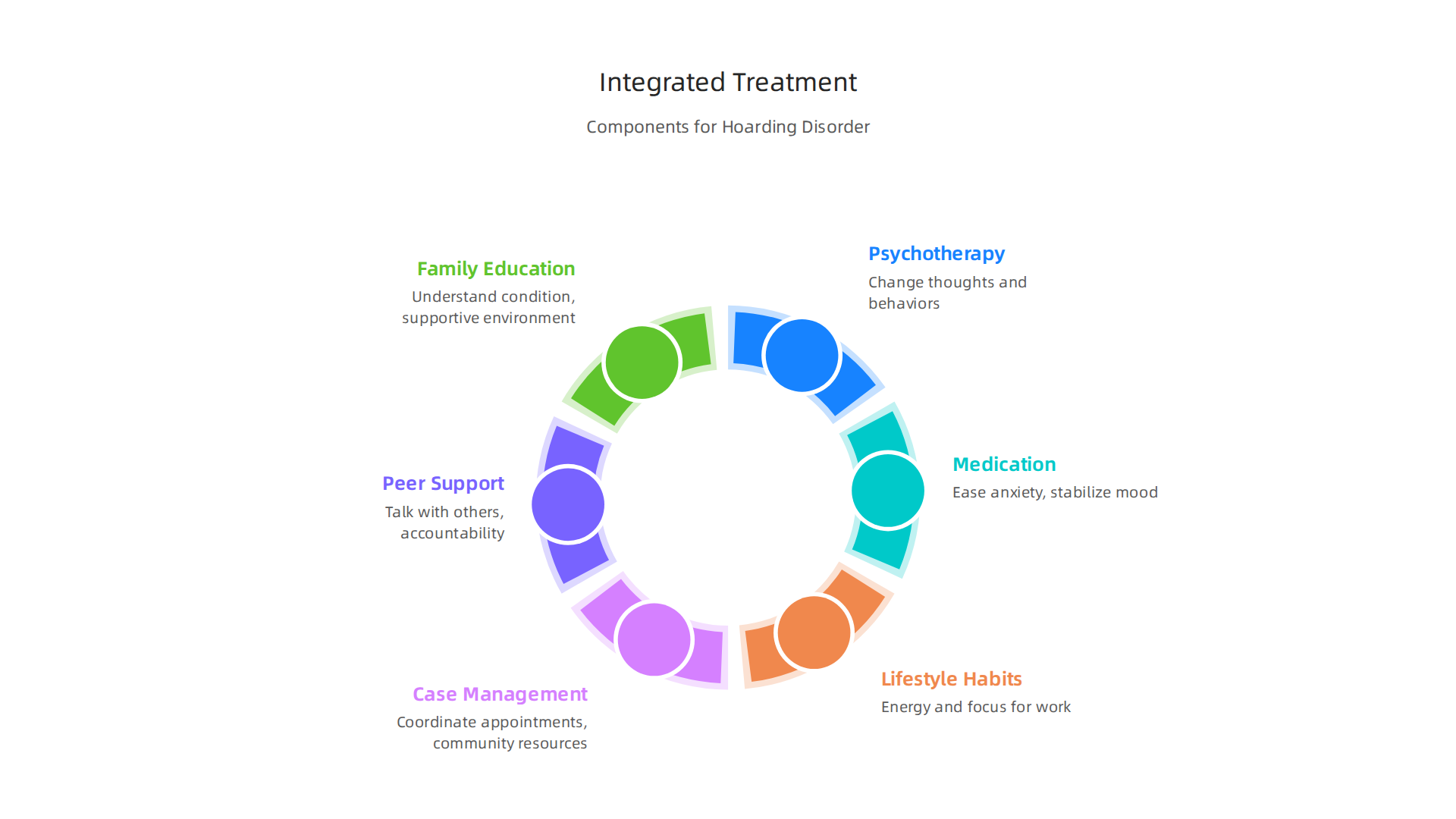
And it works better than any single method alone.
Why does combining things help so much? Because hoarding disorder affects your brain, your body, and your daily life. Cognitive behavioral therapy helps you change the thoughts and behaviors. Medication, like SSRIs, can ease the anxiety that fuels the clutter. And lifestyle habits like regular exercise and good sleep hygiene give you the energy and focus to actually do the work. The American Psychological Association notes that CBT is the best-studied treatment, but it works even better when you add other supports.
What does this look like in real life? Start with a consistent routine. Try going to bed at the same time each night. Take a short walk in the morning. These small steps build momentum. You might also need help staying on track. That is where case management and peer support come in. A case manager can help you coordinate appointments and connect you with community resources. Peer support groups let you talk with others who truly get it. The NHS recommends seeking local support groups as part of a complete treatment plan.
Family education is just as important. When your loved ones understand that hoarding is a mental health condition, not a choice, it changes everything. They learn to stop blaming and start helping. A calm, supportive home environment makes it easier to practice the skills you learn in therapy. For more on how to build these coping habits, check out this guide on coping skills for anxiety.
Remember, an integrated plan also works for co-occurring conditions. If you also struggle with cyclothymia or narcissistic personality disorder, your treatment needs to address both. The same goes for conditions like intermittent explosive disorder. A doctor who sees the whole picture can create a plan that fits you.
If some of these terms still feel confusing, do not worry. Define Anxiety Clearly gives you simple, plain language explanations of every treatment option. No jargon. Just what you need to take the next step.
Finding Help and Evaluating Treatment Options
You understand that an integrated approach works best. But where do you start when looking for a therapist or program? The key is to find a professional who specializes in hoarding disorder and uses treatments backed by research. Not every therapist has this expertise.

Begin by checking credentials. Look for a licensed psychologist, clinical social worker, or psychiatrist with training in cognitive behavioral therapy (CBT). The main treatment for hoarding disorder is CBT, a skills-based approach that targets the thoughts and behaviors driving the clutter. The Mayo Clinic confirms that CBT is the primary treatment for hoarding disorder. For people with severe hoarding, residential programs that offer daily therapy and structured support can be a good option.
When you talk to a potential therapist, ask specific questions. Do they use a specialized CBT for hoarding? Are they experienced with co-occurring conditions? For instance, if you suspect you have narcissistic personality disorder or cyclothymia, you need a provider who can treat both. Our guide on narcissistic personality disorder symptoms can help you recognize warning signs and discuss them with a professional.
Also consider the treatment format. CBT works in individual, group, or even peer-led settings. Online directories and telehealth options expand your choices, especially in underserved areas. The International OCD Foundation provides a directory of trained clinicians who treat hoarding disorder.
Before committing, ask about session structure, home visits, sorting practice, and how they track progress. Check if they accept your insurance or offer sliding scale fees.
If some terms still seem unclear, Define Anxiety Clearly gives you straightforward explanations of CBT, exposure therapy, and other treatments. Use it as your starting point.
Summary
This article explains evidence-based treatment options for hoarding disorder and cyclothymia, two often-misunderstood mental health conditions that can severely disrupt daily life. It defines each condition, why they are frequently underdiagnosed, and why early recognition matters for better outcomes. The piece details cognitive behavioral therapy (CBT) as the main proven approach for hoarding, including exposure exercises, cognitive restructuring, and organizational skills, and it reviews complementary therapies such as DBT, interpersonal therapy, and group formats. Medication is covered with practical guidance—SSRIs have modest benefit for hoarding while mood stabilizers are commonly used for cyclothymia—and the article emphasizes that meds work best combined with therapy. Finally, it outlines integrated treatment strategies, lifestyle supports, family education, and how to find clinicians experienced in treating hoarding and related conditions so readers can take concrete first steps toward recovery.