

Introduction: The Hidden Landscape of Fear
Have you ever felt a fear so strong it stopped you in your tracks, even when you knew nothing dangerous was there? You are not alone. Phobias are among the most common mental health conditions, yet they are often brushed off or misunderstood. Many people think a phobia is just a strong dislike, but the truth runs much deeper.
A phobia is a persistent, intense fear of a specific object or situation. According to Penn Medicine’s description of specific phobias symptoms and definitions, this fear is often "excessive or unreasonable" and can cause serious distress. This is not simply being nervous about a spider. It is a full-body, overwhelming reaction that can feel impossible to control.
Understanding the types of phobias is the first step toward making sense of this invisible struggle. Phobias fall into different categories, from fears of animals and natural environments to situational fears like flying or enclosed spaces. Each type has its own patterns and triggers, but they all share one thing: they are real, valid conditions that can be treated.
In this guide, we will walk through the most common types of phobias and explain how they connect to conditions like anxiety and complex stress disorder. The goal is simple: to give you clear, research-backed information without the confusing jargon. Whether you are learning for yourself or for someone you care about, this knowledge is a powerful start.
If you want to explore further, check out our overview of understanding specific phobias like fear of spiders or heights for more detailed examples.
Once you grasp the basics, the next step is to Define Anxiety Clearly so you can recognize the bigger picture of how fear and worry affect daily life.
What Are Phobias? Defining the Terms
Let’s get a clearer picture of what a phobia really is according to experts. A phobia is not just a strong dislike or a passing nervous feeling. It is a deep, lasting fear of a specific thing or situation. This fear feels so real that your body reacts as if you are in actual danger, even when you are perfectly safe.
Medical professionals use two main guides to diagnose phobias: the DSM-5 and the ICD-11. Both agree that a phobia must cause marked fear or anxiety that is out of proportion to the actual risk. According to the specific phobia diagnostic criteria from the DSM-5-TR, the fear is almost always triggered immediately by the object or situation. It also leads to active avoidance or extreme distress, and it lasts for six months or longer. That is a key difference from a short-lived worry.
So how is a phobia different from general anxiety or a panic attack? General anxiety is a broad, ongoing sense of worry about many things. A panic attack can happen without a clear trigger. But a phobia is pinned to one specific trigger.
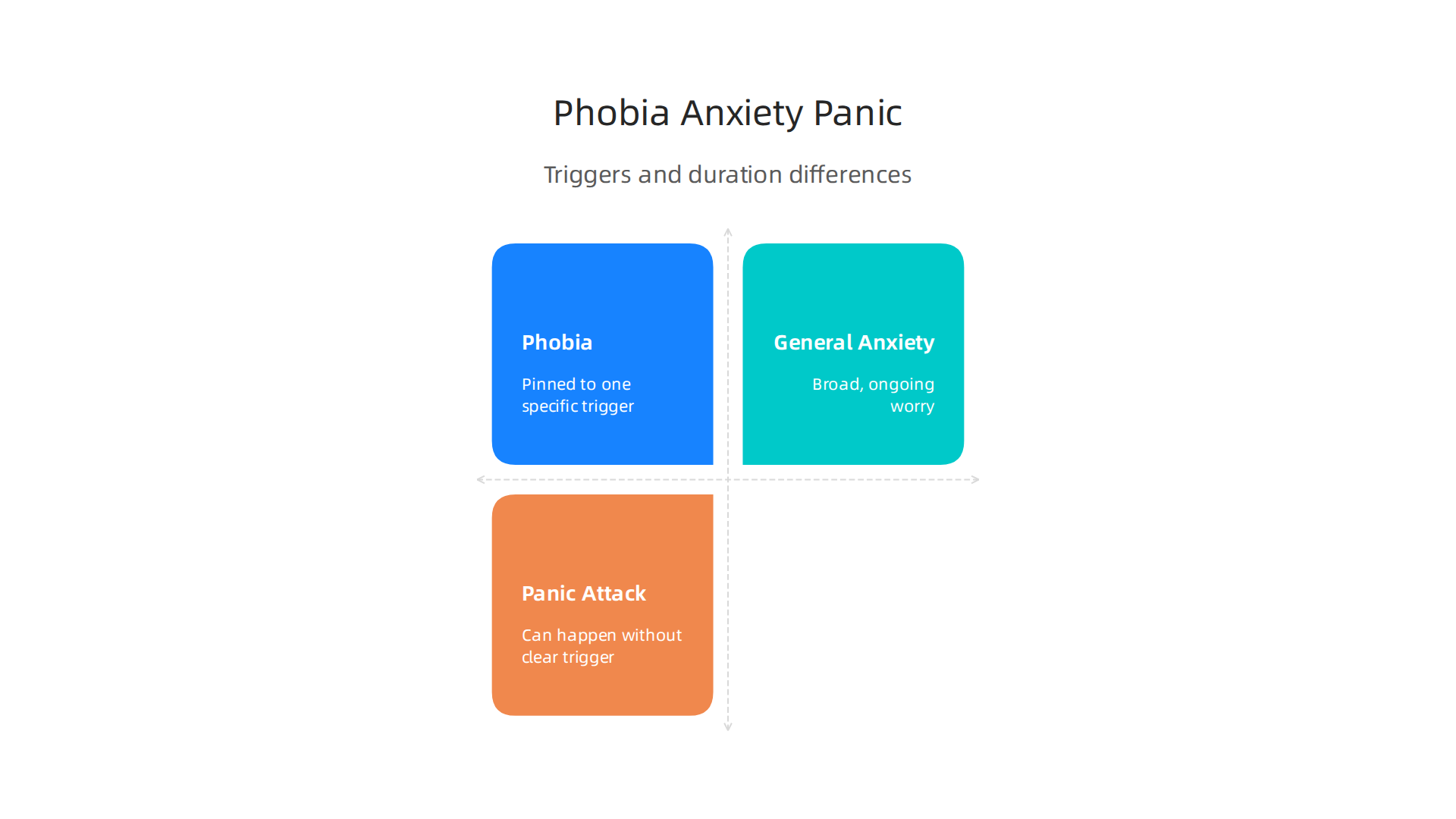
For example, someone with a fear of dogs will feel intense fear only when a dog is near or even just pictured. The trigger is clear and consistent. This focus makes phobias easier to identify, even though the fear itself feels just as overwhelming.
Understanding this definition matters because it helps you spot the patterns in your own life or in someone you care about. If you recognize a specific trigger that causes an extreme reaction, it might be a phobia rather than general anxiety. And that changes how you approach treatment.
To learn more about how sudden fear attacks compare, read up on anxiety attack symptoms so you can tell the difference between a phobic reaction and a full panic episode.
The Anxiety Disorder Spectrum: Where Do Phobias Fit?
Now that you know what makes a phobia different from everyday fear, it helps to see the bigger picture. Phobias are not isolated. They belong to a family of conditions called anxiety disorders. These conditions all involve intense fear or worry, but they show up in different ways.
Think of the anxiety disorder spectrum as a range. On one end you have generalized anxiety disorder (GAD), where worry spreads across many parts of life with no single trigger. On the other end you have specific phobias, where the fear is locked onto one thing, like heights or spiders. Somewhere in the middle you find panic disorder, social anxiety disorder, and agoraphobia.
So what sets phobias apart? The trigger. A person with anxiety disorders types and symptoms like GAD feels on edge almost all the time, even without a clear reason. Someone with a phobia only feels that intense fear when they face their specific trigger. The rest of the time, they may feel perfectly fine. That focused fear makes phobias easier to spot and treat than some other anxiety disorders.
But here is the good news. Every condition on this spectrum is treatable. Understanding that phobias are just one type of anxiety disorder helps you see that you are not alone. And it points you toward the right kind of help.
If you want to clearly understand all the terms and conditions we have talked about, you can Define Anxiety Clearly and build a solid foundation for your mental health knowledge.
The Three Main Categories of Phobias
You already know that phobias are a type of anxiety disorder. But did you know that the DSM-5, the manual doctors use to diagnose mental health conditions, groups all phobias into just three main categories? Understanding these different types of phobias helps you figure out what you or someone you care about might be dealing with. It also points you toward the right kind of help.
The three categories are specific phobia, social anxiety disorder (also called social phobia), and agoraphobia.
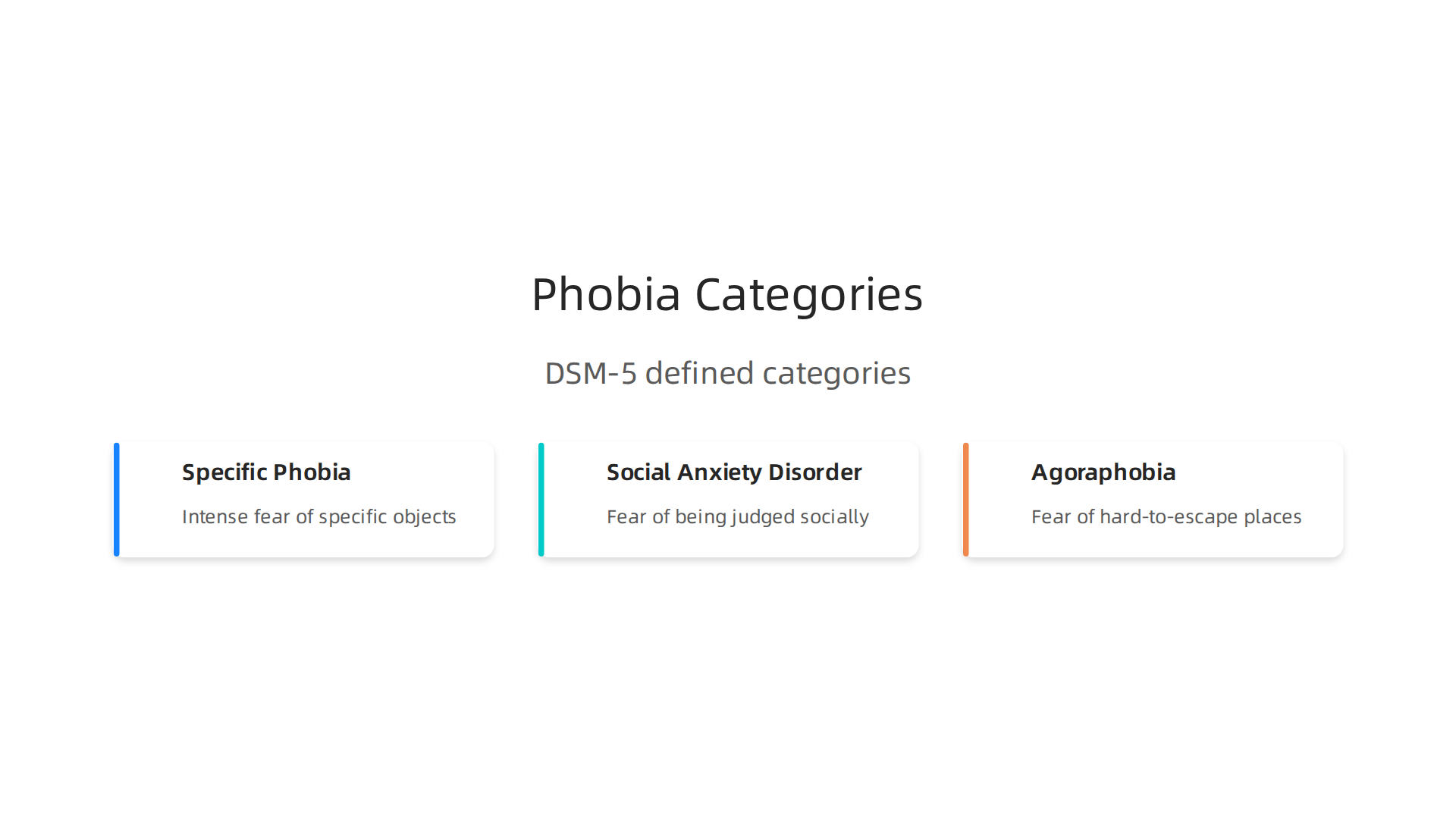
Each one has its own set of triggers, age when it usually starts, and best treatment approach.
Specific phobia is the most common type. It is an intense fear of a specific object or situation. Things like flying, heights, spiders, needles, or blood. The fear is way out of proportion to the actual danger. As the DSM-5 criteria for specific phobia explains, the fear must be marked and last for at least six months. Many people with specific phobia know their fear is irrational, but they cannot control it.
Social anxiety disorder is the fear of being judged or embarrassed in social situations. It goes beyond simple shyness. People with this condition may avoid parties, public speaking, or even eating in front of others. It often starts in the early teens.
Agoraphobia is the fear of being in situations where escape might be hard or help might not be available if panic strikes. This can include open spaces, crowded places, public transit, or being outside the home alone. It often appears after panic attacks.
Knowing these three categories lets you name what you are experiencing. That is the first step toward getting better. If you want to learn more about one common type, check out this guide on specific phobias and common triggers. And if you ever feel confused by all the terms, take a moment to Define Anxiety Clearly and build a solid foundation for your mental health knowledge.
Specific Phobias: The Most Common
Let’s zoom in on the most common category: specific phobias. A specific phobia is an intense, irrational fear of a particular object or situation. This fear goes way beyond normal nervousness.
Specific phobias are very widespread. One Phobia facts and statistics 2026 report highlights that specific phobias are by far the most prevalent phobia type. The lifetime prevalence rates for specific phobias show that about 12.5% of adults will face one.
The DSM-5 groups them into five subtypes:
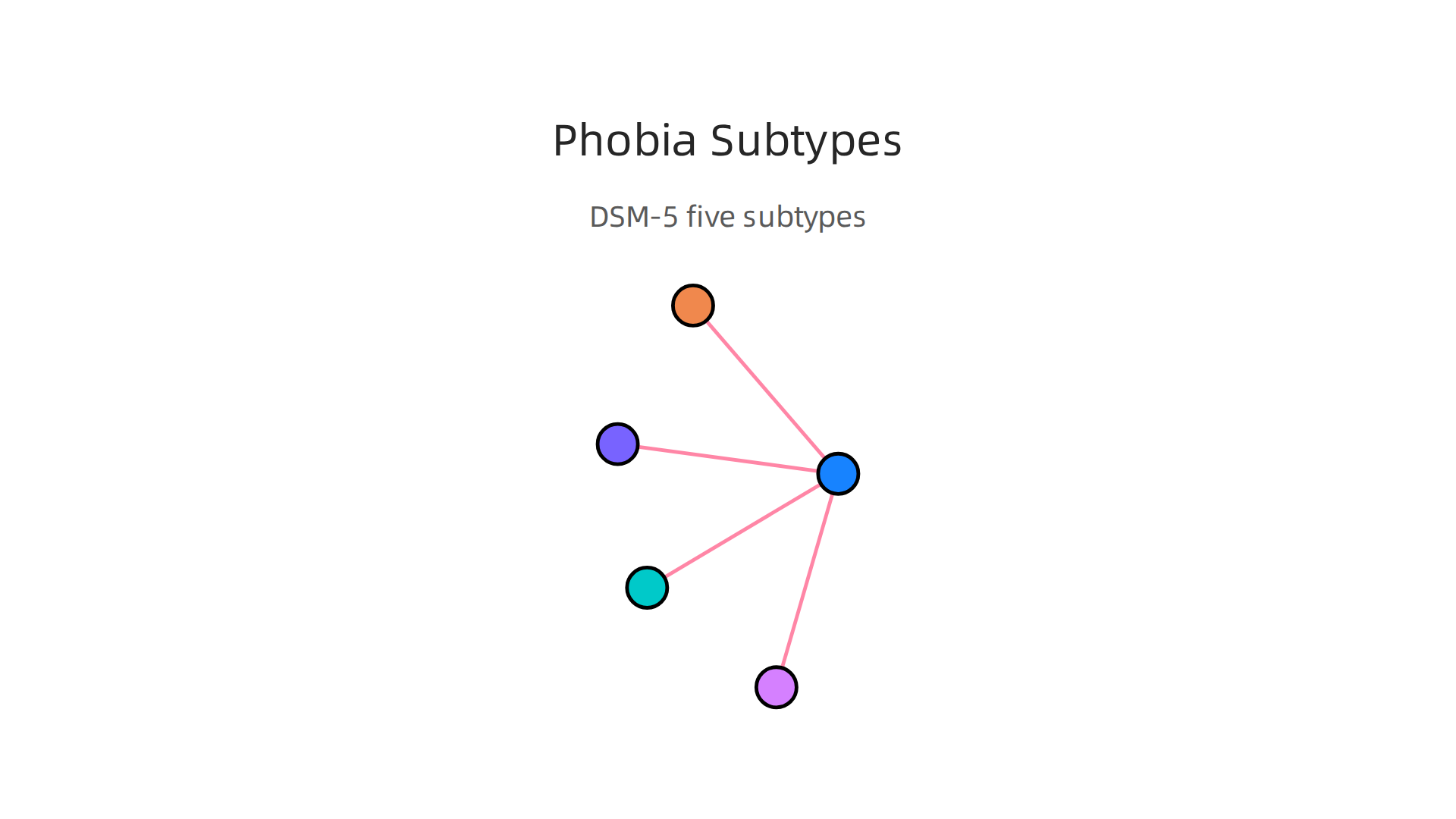
- Animal type: Spiders, dogs, snakes, or insects.
- Natural environment type: Heights, storms, or water.
- Blood-injection-injury type: Needles, blood draws, or surgery.
- Situational type: Flying, elevators, or small spaces.
- Other type: Choking, vomiting, or loud sounds.
Some triggers are common, but others are unusual. You can read more about rare phobias.
The key takeaway is that specific phobias are highly treatable.
Social Anxiety Disorder (Social Phobia)
But there is another common type among the different types of phobias: social anxiety disorder. Also called social phobia, this is not about being a little shy. It is a deep fear of being judged, embarrassed, or humiliated in everyday social situations.
People with social phobia often worry for days before a meeting, class, or even a casual chat.

They may blush, sweat, or feel their heart race. The fear is so strong that they start avoiding things like eating in public, speaking up, or making phone calls.
This condition usually starts in the teenage years. That can make school, making friends, and building confidence really hard. Unlike shyness, social phobia is a complex stress disorder that actually gets in the way of daily life. It can hurt education, career, and relationships.
What causes it? A mix of things. Family history plays a role. Research on the heritability of fears and phobias shows that genetics can make someone more likely to develop social anxiety.
The good news is that help works. If you or a teen you know struggles with this, learning about the signs is the first step. Check out this guide on teen anxiety signs to understand what to look for and how to offer support. With the right tools, social phobia does not have to control your life.
Agoraphobia: Fear of Panic
Now let’s look at another type among the different types of phobias: agoraphobia. This is not a fear of a specific object or situation like spiders or heights. Instead, it is a fear of being in places where escape might feel hard or help might not reach you if panic symptoms hit.
Common triggers include open spaces, crowded stores, public transportation, and even being outside the home alone.

People with agoraphobia often worry about having a panic attack and not being able to get to safety. This fear can get so strong that they stop leaving the house. That makes it a complex stress disorder that affects work, friendships, and daily life.
Agoraphobia is often linked to panic disorder. A person might have a panic attack in a store, then start avoiding stores, then avoid going out at all. The cycle can be hard to break.
If you or someone you know is struggling with this, there is help. Understanding what you are dealing with is the first step toward getting better. You can start by learning more about panic attack symptoms and what to do in the moment. That knowledge can build confidence.
Once you have named the pattern, you can begin to face it. For a clear foundation on all anxiety terms and conditions, check out this resource to Define Anxiety Clearly. It gives you simple definitions so you can understand your experience and take the next step.
A Closer Look at Specific Phobias
Now that you understand agoraphobia, let’s zoom in on the most common type among the different types of phobias: specific phobias. These are intense fears of a particular object or situation. The fear is way out of proportion to the actual danger. But it feels very real.
You have probably heard of some of these. Acrophobia is the fear of heights. Arachnophobia is the fear of spiders. Claustrophobia is the fear of enclosed spaces. Aviophobia is the fear of flying. These are just a few examples. There are hundreds of others.
Specific phobias are not rare. According to the Specific Phobia statistics from NIMH, about 9.1% of US adults have had a specific phobia in the past year. That is nearly 1 in 10 people. Women are more likely to be affected than men.
The key is that the fear leads to avoidance. A person with a fear of flying might never take a vacation by plane. Someone with a fear of spiders might refuse to go into the basement. That avoidance can shrink your life over time. It limits what you can do and where you can go.
When you learn about the many different types anxiety can take, it helps you feel less alone. You see that these are real conditions with names. They are not just personal weaknesses. For more examples, check out this article on understanding specific phobias like fear of long words, spiders, and heights. It lists some unusual ones too.
The good news is that specific phobias are very treatable. Therapy can teach you to face the fear slowly and safely. Many people get better.

The first step is knowing what you are dealing with. That knowledge alone can reduce shame and open the door to help.
For a deeper look at how understanding mental health patterns can build resilience, check out the Youth Safety Case Study. It shows how recognizing symptoms early can lead to stronger coping skills.
Symptoms: How Phobias Manifest Mind and Body
When you have a phobia, your body reacts before your brain has time to think. The moment you see, hear, or even imagine the thing you fear, your system kicks into high gear. This is not just being nervous. It is a full physical response.
What does that feel like? Your heart starts racing. Your palms get sweaty. You might tremble or feel short of breath.
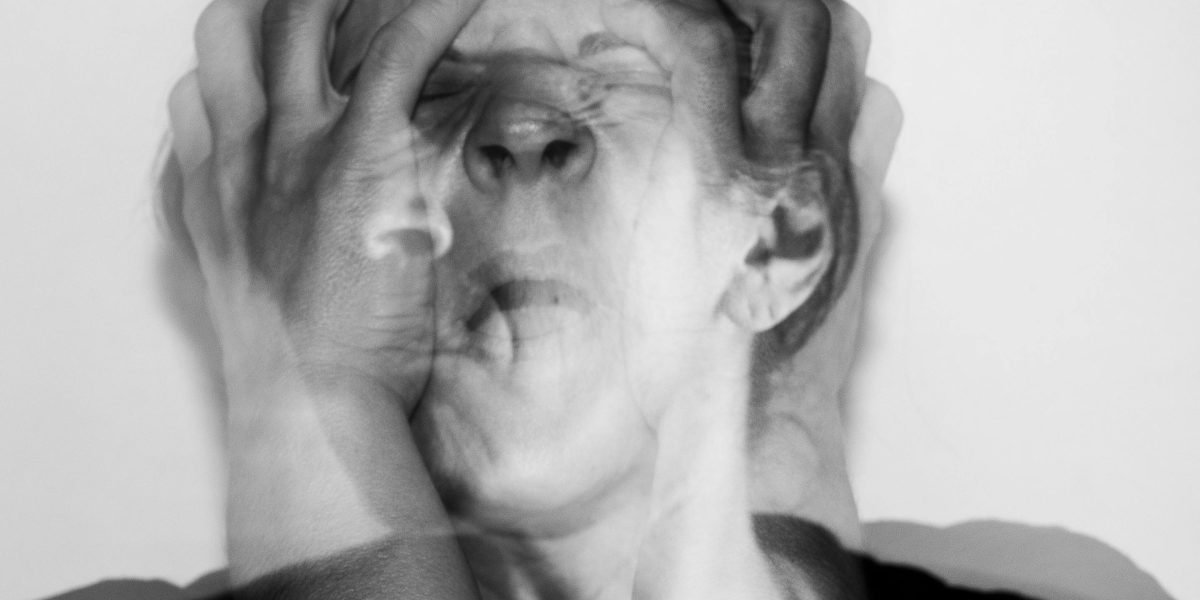
Some people feel dizzy or nauseous. Others feel a strong urge to run away or hide. These are all part of the body’s natural fight-or-flight response. But for someone with a phobia, it happens at the wrong time.
These symptoms of anxiety disorders like rapid heartbeat and sweating are very real. They are not imagined. The body is producing adrenaline and other stress chemicals. The fear is immediate and nearly always provoked by the presence or even the anticipation of the phobic object.
The biggest clue that someone has a phobia is avoidance. You stop going places or doing things that might bring you near the fear. Over time, avoidance makes the phobia worse. Your brain learns that the only way to feel safe is to stay away. That cycle can keep you stuck.
If you recognize these signs in yourself or someone you know, you are not alone. Understanding the symptoms is the first step. For more on what these attacks feel like, see this guide on anxiety attack symptoms and how to recognize them.
The good news is that once you name what is happening, you can start to address it. Get beyond symptoms and Define Anxiety Clearly to understand the system behind the fear.
Causes and Risk Factors: Why Do Some Develop Phobias?
You might wonder why one person develops a phobia while someone else does not. The answer isn’t simple. It comes from a mix of your genes, your life experiences, and even how you learn by watching others.
Your family history matters. The way your body handles fear is partly inherited. A study on the genetics of fear conditioning found that the fear response in humans is between 35% and 45% heritable. That means nearly half of your tendency to react strongly may come from your DNA. But genes are not the whole story.
Life experiences shape the rest. A single scary event, like being bitten by a dog as a child, can create a lasting phobia. Psychologists call this classical conditioning. Your brain learns to pair the dog with danger. Years later, just seeing a dog can trigger those racing heart and sweaty palms we talked about.
You can also pick up fear without going through the trauma yourself. This is called vicarious learning. If you grew up watching a parent panic at the sight of a spider, you might feel the same way. Your brain copies their fear response and treats it as your own.
Certain personality traits raise the risk too. People who are naturally more anxious or emotionally sensitive, a trait called neuroticism, are more likely to develop phobias. This same sensitivity appears across many different types of anxiety.
So whether you are dealing with a complex stress disorder or a single specific fear, the causes usually trace back to this combination of genetics, learning, and temperament. Understanding why it started can help you choose the right path forward. For a deeper look at how these behavioral mechanisms work, check out The Science of Gamification, which explains the science behind how we learn and unlearn fear patterns.
If you want to explore the most common types of phobias and what makes each one unique, read this guide on understanding specific phobias.
Treatment Options: Evidence-Based Approaches
Now that you understand what causes phobias, let’s look at how to treat them. The good news is that phobias are very treatable. With the right help, most people can overcome even the most stubborn fears.
The gold standard treatment for phobias is cognitive behavioral therapy, or CBT. CBT helps you change how you think about the thing you fear and how you act around it. A big part of CBT is exposure therapy. This involves slowly and safely facing your fear in small steps. For example, if you fear heights, you might start by looking at a picture of a tall building. Then you might stand on a low step stool. Step by step, your brain learns that the fear signal is wrong. Studies show that about 80 to 90 percent of people who complete CBT improve a lot. And if you stick with exposure therapy, over 90 percent of people with a specific phobia see real results. That is a pretty strong track record.
For some people, especially those with severe phobias like social anxiety or agoraphobia, medications can help. Doctors may prescribe antidepressants called SSRIs to lower general anxiety. In some cases, they use benzodiazepines for short term relief during scary moments. But medication alone is not usually the best long term answer. It works best when combined with therapy.
You can also help yourself with simple daily habits. Mindfulness exercises calm your nervous system. Gradual self exposure, where you face a small fear on your own, can build courage. Learning about your phobia through psychoeducation takes away some of its power. The more you understand how fear works, the less scary it feels.
For practical tips you can use at home, check out our guide on evidence based coping skills for anxiety.
If you have a complex stress disorder or a mix of different types anxiety, your treatment plan may need to cover both the phobia and the underlying anxiety. That is okay. The same tools work well for all these conditions.
Summary
This article explains what phobias are, how they fit within the broader anxiety disorder spectrum, and why they are more than just strong dislikes. It covers DSM diagnostic criteria, the three main categories—specific phobia, social anxiety disorder, and agoraphobia—and the common subtypes of specific phobias such as animals, heights, blood-injection-injury, and situational fears. You will learn how phobic reactions show up in body and mind, what causes increase risk (genes, learning, traumatic events), and how avoidance maintains the problem. The guide also summarizes evidence-based treatments, emphasizing CBT and exposure therapy, when medication can help, and practical self-help strategies like mindfulness and gradual exposure. After reading, you should be able to recognize phobic patterns, distinguish phobias from other anxiety problems, and know the next steps to get effective care or begin safe self-help.